Best Ways to Improve Instagram Engagement: Complete Guide for 2026
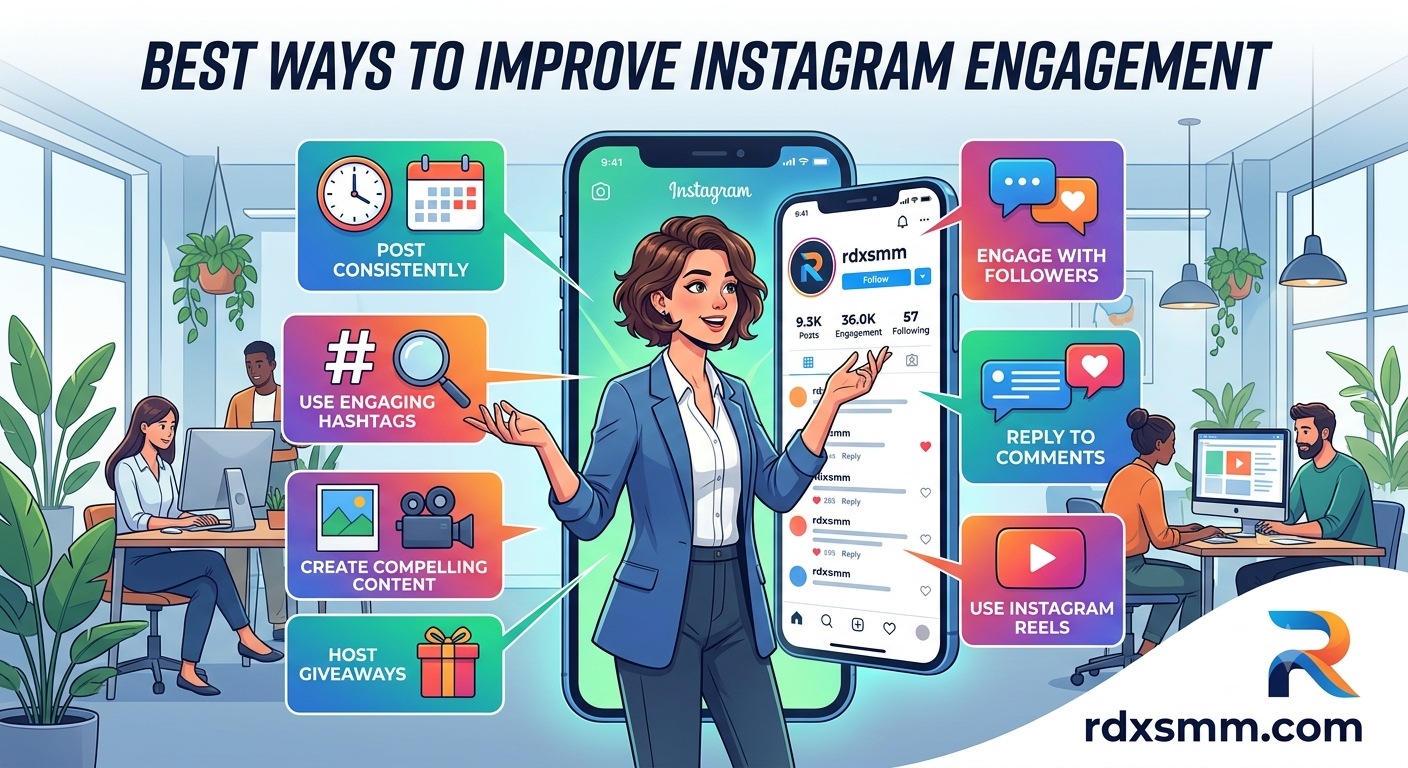
Best Ways to Improve Instagram Engagement: Complete Guide for 2026
Instagram engagement is one of the most important indicators of how people respond to your content. Likes, comments, shares, saves, profile visits, replies and other interactions can help you understand whether your content is actually connecting with your audience.
But improving Instagram engagement isn't simply about getting more likes.
A successful Instagram strategy focuses on creating content that people genuinely want to watch, save, share, discuss and revisit.
If you're trying to grow an Instagram account, build a personal brand, promote a business or improve your social media marketing strategy, this guide explains the best ways to increase Instagram engagement naturally.
What Is Instagram Engagement?
Instagram engagement refers to the actions people take after seeing or interacting with your content.
Common engagement actions include:
- Likes
- Comments
- Shares
- Saves
- Story replies
- Profile visits
- Follows
- Reel interactions
- Direct messages
- Link or profile actions
For example, if you publish an Instagram Reel and viewers share it with their friends, those shares are an important form of engagement.
Instagram's ranking systems use predictions about different interactions to help determine which content may be interesting to users. Meta has explained that actions such as liking, commenting, saving and other interactions can be incorporated into ranking predictions.
That's why creating content people actually want to interact with is more valuable than simply trying to increase a single metric.
Why Is Instagram Engagement Important?
Having thousands of followers doesn't necessarily mean that an account has a strong community.
Imagine two accounts:
Account A
- 50,000 followers
- Very few comments
- Few shares
- Few saves
- Low audience interaction
Account B
- 8,000 followers
- Frequent comments
- High shares
- Strong Story replies
- Regular saves
The second account may have a much more active community.
Engagement can help you understand:
- What your audience likes
- Which topics are valuable
- Which formats perform well
- What content people share
- What questions your audience has
- Which posts generate profile visits
- Which content attracts new followers
For creators and businesses, these insights can be more useful than follower count alone.
1. Know Your Target Audience
One of the first steps to improving Instagram engagement is understanding who you're creating content for.
Ask yourself:
Who do I want to reach?
For example, a fitness account might target:
- Beginners
- Gym enthusiasts
- People trying to lose weight
- Home-workout audiences
- Athletes
A digital marketing account might target:
- Small businesses
- Content creators
- Influencers
- Freelancers
- Marketing professionals
Once you understand your audience, you can create content around their interests, questions and problems.
Create content that answers real questions
Instead of asking:
"What should I post today?"
Ask:
"What problem can I solve for my audience today?"
This small change can significantly improve the quality of your content strategy.
2. Create Content Worth Saving
Saves can be a valuable signal that people consider your content useful enough to return to later.
Create posts that people may want to reference again.
Examples include:
- Checklists
- Tutorials
- Step-by-step guides
- Tips
- Templates
- Educational carousels
- Mistakes to avoid
- Resource lists
- Beginner guides
For example:
Instead of:
"Instagram Tip 🔥"
Create:
"7 Instagram Profile Mistakes That Can Make Your Account Harder to Understand"
The second concept gives people a specific reason to read and potentially save the post.
3. Make Your Content Shareable
Shares can introduce your content to people beyond your existing audience.
Think about the types of content people naturally send to friends.
Examples:
Educational
"5 Instagram mistakes every new creator should avoid."
Relatable
"When you spend two hours editing a Reel and it gets 200 views."
Useful
"Instagram content checklist before you publish."
Inspirational
"Your first 1,000 followers won't come overnight. Keep improving."
The goal isn't to manipulate people into sharing.
The goal is to create something that is genuinely worth sharing.
4. Improve Your Instagram Reels
Reels are an important format for many Instagram growth strategies because they can introduce content to people who don't already follow an account.
Meta describes Explore as a major recommendation surface where people discover content from accounts they don't necessarily follow.
Try creating Reels around:
- Tutorials
- Educational tips
- Quick explanations
- Behind-the-scenes content
- Product demonstrations
- Storytelling
- Industry updates
- Common mistakes
- Frequently asked questions
Start with a strong hook
The first part of a Reel should quickly communicate why someone should continue watching.
For example:
Weak:
"Hey everyone, welcome back to my page..."
Better:
"Getting low views on Instagram Reels? Check these three things."
The second opening immediately establishes a problem.
5. Use Strong Hooks
A hook is the opening idea that captures attention.
Good hooks can be:
Question hooks
"Why are your Instagram Reels getting fewer views?"
Problem hooks
"If your Instagram engagement has dropped, check this."
Curiosity hooks
"Most creators overlook this Instagram setting."
List hooks
"5 ways to improve Instagram engagement."
Tutorial hooks
"Here's how to create an Instagram carousel people actually read."
Your hook should accurately represent the content that follows.
Avoid clickbait that promises something the content doesn't deliver.
6. Encourage Genuine Conversations
If you want more comments, give people something worth responding to.
Instead of ending every caption with:
"Comment YES!"
ask a question relevant to the topic.
For example:
"Which Instagram format currently works best for your account: Reels, carousels or Stories?"
Or:
"What's your biggest problem with Instagram growth right now?"
These questions give your audience an actual reason to participate.
7. Reply to Your Comments
Posting content is only one side of community building.
When people leave meaningful comments, respond to them.
A good reply can:
- Continue the conversation
- Answer a question
- Provide additional information
- Encourage another response
- Make followers feel noticed
Don't use identical automated replies everywhere.
A genuine response is more useful than:
"Thanks ❤️"
on every comment.
8. Use Instagram Stories for Interaction
Stories can be useful for creating regular conversations with your existing audience.
Try using:
- Polls
- Questions
- Quizzes
- Sliders
- Behind-the-scenes content
- Quick tutorials
- Product updates
- Audience opinions
For example:
Story 1:
"Which content should I make next?"
Option A: Instagram SEO
Option B: Reels tips
Then use the result to decide what to publish next.
This turns your audience into part of your content strategy.
9. Create Instagram Carousel Posts
Carousels can be excellent for educational content.
A simple structure might be:
Slide 1: Strong headline
Slide 2: Problem
Slide 3: Tip #1
Slide 4: Tip #2
Slide 5: Tip #3
Slide 6: Mistakes to avoid
Slide 7: Summary
Slide 8: Call to action
For example:
"7 Ways to Improve Instagram Engagement"
Slide 1: 7 Ways to Improve Instagram Engagement
Slide 2: Understand your audience
Slide 3: Create saveable content
Slide 4: Improve your hooks
Slide 5: Use Stories
Slide 6: Reply to comments
Slide 7: Analyze your insights
Slide 8: Start applying the strategy
10. Improve Your Captions
A caption doesn't need to be extremely long.
It needs to be useful.
A good caption can:
- Introduce the topic
- Explain the problem
- Give useful information
- Encourage discussion
For example:
Your Instagram engagement isn't always about posting more.
Start by understanding what your audience actually wants to see. Create useful content, experiment with different formats, respond to comments and study your analytics.
Which strategy are you going to try first?
Simple, relevant and easy to understand.
11. Use Relevant Hashtags
Hashtags can help categorize your content, but they shouldn't replace good content.
Use hashtags that genuinely relate to your topic.
For a social media marketing post, relevant categories might include:
- Instagram marketing
- Social media marketing
- Content marketing
- Instagram tips
- Digital marketing
Don't use unrelated viral hashtags simply because they have a large number of posts.
Instagram itself has included hashtag guidance within its creator Best Practices resources.
12. Make Your Profile Easy to Understand
When someone discovers your content, they may visit your profile before deciding whether to follow you.
Your profile should clearly communicate:
Who are you?
What do you post?
Why should someone follow you?
Improve:
- Profile picture
- Username
- Name field
- Bio
- Pinned posts
- Highlights
- Website/link
If your profile looks confusing, you may lose potential followers even when your individual posts perform well.
13. Use Consistent Content Themes
Instead of posting completely unrelated topics, create a few recurring content pillars.
For example, a social media marketing account could have:
Pillar 1 — Instagram Tips
Growth and engagement strategies.
Pillar 2 — Tutorials
Step-by-step guides.
Pillar 3 — Social Media News
Relevant platform developments.
Pillar 4 — Case Studies
Examples and lessons.
Pillar 5 — Tools
Useful marketing tools and resources.
This makes your account easier for your audience to understand.
14. Study Your Instagram Insights
Don't guess what works.
Look at your account's available insights and compare different posts.
Track metrics such as:
- Reach
- Views
- Likes
- Comments
- Shares
- Saves
- Profile visits
- Follows
Instagram's own creator Best Practices includes guidance on understanding engagement metrics and provides personalized tips through the professional dashboard.
Find your winners
Suppose you publish:
- 10 Reels
- 5 carousels
- 10 Stories
You discover that educational Reels consistently generate more shares and profile visits.
That's useful information.
Instead of randomly changing your strategy, create more content around the themes that your audience has already shown interest in.
15. Experiment With Different Content Formats
Don't assume that one format will always perform best.
Experiment with:
- Reels
- Carousels
- Single-image posts
- Stories
- Live content
- Q&A content
Then compare the results.
Your audience may prefer educational carousels while another account's audience may respond better to short videos.
There is no universal content format that guarantees success for every account.
16. Collaborate With Relevant Creators
Collaboration can introduce your content to another relevant audience.
Look for creators who have:
- Similar audiences
- Complementary topics
- Genuine engagement
- Compatible content
Possible collaborations include:
- Joint Reels
- Interviews
- Q&A sessions
- Live discussions
- Tutorials
- Educational posts
Focus on audience relevance, not just follower count.
17. Create Original Content
Don't build your entire strategy around copying other accounts.
Study successful content, but add your own:
- Experience
- Examples
- Opinions
- Visual style
- Data
- Explanations
- Storytelling
Meta has also emphasized originality in its recommendations work, including changes intended to give original creators more opportunities to reach new audiences.
Originality gives your account a stronger reason to exist.
18. Post Consistently
Consistency helps you maintain an active relationship with your audience.
However, consistency doesn't mean publishing low-quality content every few hours.
A realistic schedule might be:
Monday: Reel
Tuesday: Story + poll
Wednesday: Carousel
Thursday: Reel
Friday: Story Q&A
Saturday: Educational post
Sunday: Analytics review
Adjust the schedule according to your audience and available resources.
19. Use Calls to Action Carefully
A call to action tells the audience what they can do next.
Examples:
Save this guide for later.
Share this with a creator who needs it.
What's your biggest Instagram challenge?
Follow for more Instagram marketing tips.
The CTA should match the content.
Don't ask for five different actions in every post.
20. Don't Obsess Over Likes Alone
Likes are only one part of Instagram engagement.
A post with fewer likes but many saves, shares and profile visits may be extremely valuable.
For example:
Post A
10,000 views
700 likes
5 saves
Post B
5,000 views
300 likes
200 saves
Post B may contain much more useful information for its audience.
That's why you should evaluate several metrics instead of judging content solely by likes.
Meta's published ranking information similarly describes multiple predicted actions rather than one single engagement metric.
21. Avoid Engagement Bait
Trying to manipulate engagement with misleading tactics can damage the quality of your community.
Avoid things like:
- Fake giveaways
- Misleading captions
- Irrelevant hashtags
- Spam comments
- Engagement groups
- Repetitive comments
- Misleading promises
Instead, create content that naturally earns interaction because people find it interesting or useful.
22. Use an SMM Panel as a Marketing Tool, Not a Replacement for Content
If you're researching social media marketing services, an SMM panel can provide a centralized way to browse and manage different promotional services.
RdxSMM.com is an SMM panel that users can explore for available social media marketing services.
However, no external service should replace the fundamentals of building a real social media presence.
A stronger overall strategy is:
Content → Engagement → Analytics → Optimization → Promotion
Build the audience first; use marketing tools as part of a broader strategy.
23. Build a 30-Day Instagram Engagement Strategy
Here's a simple framework you can follow.
Week 1 — Understand Your Audience
Research:
- Target audience
- Common questions
- Popular topics
- Content competitors
- Problems your audience experiences
Create your content pillars.
Week 2 — Improve Content
Publish:
- 2–3 Reels
- 1–2 carousels
- Daily or regular Stories
- One Q&A or interactive post
Focus on stronger hooks and useful information.
Week 3 — Analyze
Review:
- Shares
- Saves
- Comments
- Profile visits
- Follows
- Reach
- Views
Identify your strongest topics.
Week 4 — Double Down
Create more content based on your strongest results.
Don't blindly repeat the same post.
Instead, take the winning topic or concept and approach it from a different angle.
Instagram Engagement FAQ
How can I increase Instagram engagement?
Create useful, original content that matches your audience's interests. Focus on strong hooks, Reels, carousels, Stories, meaningful conversations, relevant hashtags and regular analysis of your performance.
Why is my Instagram engagement low?
Low engagement can have many causes, including weak content-audience fit, unclear positioning, inconsistent publishing, poor hooks, or content that doesn't give people a reason to interact.
Review your analytics and compare your strongest and weakest posts.
What type of Instagram content gets the most engagement?
There is no single format that works for every account. Educational, entertaining, relatable and useful content can all perform well when they match the audience.
Are comments more important than likes?
Don't assume one metric is universally more important. Instagram's systems consider multiple predicted interactions, including actions such as likes, comments and saves.
How can I get more comments on Instagram?
Create content that invites genuine discussion. Ask relevant questions, discuss interesting topics and respond to existing comments rather than using repetitive engagement bait.
Do Instagram Reels help engagement?
Reels can be an effective format for reaching audiences and generating interactions, but results depend on the content, audience and execution.
Should I buy Instagram engagement?
Artificially increasing a number doesn't necessarily create an interested audience. For sustainable growth, focus primarily on relevant content and genuine audience interaction.
How often should I post on Instagram?
There isn't one universal number. Choose a schedule you can maintain while keeping your content useful and consistent.
Final Thoughts
Improving Instagram engagement isn't about finding one secret algorithm trick.
It's about creating content that people genuinely want to consume and interact with.
Focus on:
Know your audience → Create useful content → Improve your hooks → Use Reels and Stories → Encourage real conversations → Study analytics → Repeat what works.
Most importantly, don't judge your Instagram strategy by follower count or likes alone.
Track the bigger picture: shares, saves, comments, profile visits, follows, reach and overall audience response.
If you're looking for an SMM platform to complement your social media marketing workflow, you can explore RdxSMM.com and review the services available on the platform.
Build useful content first. Build genuine engagement second. Then scale what works. :::