How Instagram Reels Reach Works: Complete Guide to Getting More Views
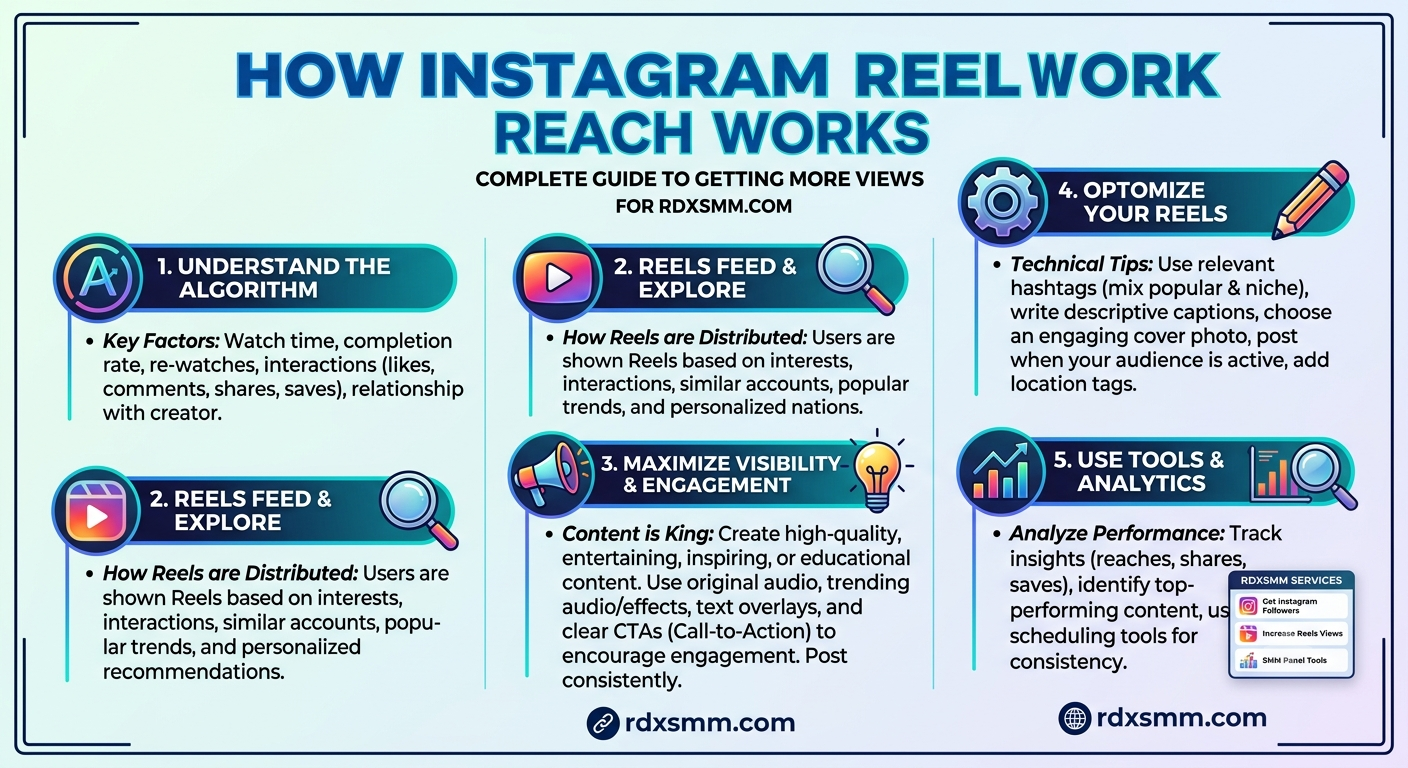
How Instagram Reels Reach Works: Complete Guide to Getting More Views
Instagram Reels have become one of the most important ways for creators, influencers, brands, and businesses to reach new audiences.
But one question comes up again and again:
How does Instagram Reels reach actually work?
Why does one Reel get a few hundred views while another reaches thousands or even millions? Why do some Reels continue gaining views days after publishing? And what can you do to increase the chances of your content being discovered by people who don't follow you?
There isn't one magic setting that guarantees more views. Instagram uses recommendation and ranking systems to determine which content is more likely to be relevant and interesting to each viewer.
In this guide, we'll explain how Instagram Reels reach works, what factors can influence performance, and how you can create Reels with stronger opportunities for discovery.
What Is Instagram Reels Reach?
Instagram Reels reach refers to the number of unique Instagram accounts that see your Reel.
This is different from views.
For example, if one person watches your Reel multiple times, those multiple plays can contribute to the video's view count, while the person may still represent only one reached account.
That's why creators should look at several metrics rather than judging a Reel only by its view count.
Important metrics can include:
- Accounts reached
- Views
- Watch time
- Likes
- Comments
- Shares
- Saves
- Profile visits
- Follows generated from the Reel
Together, these metrics can help you understand how people are responding to your content.
How Does Instagram Decide Which Reels to Show?
Instagram doesn't simply show every Reel to every follower.
Its recommendation systems try to predict what individual users are likely to find interesting.
This means two people can open Instagram at the same time and see completely different Reels.
Your Reel may be shown to:
- Existing followers
- People who have interacted with your content
- People interested in similar topics
- Users who engage with related content
- Other audiences Instagram considers relevant
The exact distribution can vary from Reel to Reel.
1. Watch Time Matters
One of the most useful metrics for understanding Reel performance is watch time.
If viewers immediately swipe away from your video, it may indicate that the content isn't holding their attention.
On the other hand, if viewers continue watching, your Reel has a stronger engagement signal.
This is why the beginning of a Reel is extremely important.
Instead of taking a long time to introduce the topic, get directly to the point.
For example:
Weak opening:
"Hey guys, welcome back to my page. Today we're going to discuss..."
Stronger opening:
"Your Instagram Reels aren't getting views? Check these three mistakes."
The second opening immediately gives the viewer a reason to continue.
2. Viewer Retention Can Make a Difference
Retention describes how well your video holds viewers' attention throughout the content.
Imagine two Reels:
Reel A: 20 seconds long, but most viewers leave after 3 seconds.
Reel B: 20 seconds long, and viewers watch most of it.
Reel B is giving you a much stronger indication that viewers found the content interesting.
To improve retention:
- Remove unnecessary introductions
- Keep the video focused
- Use clear editing
- Change visuals when appropriate
- Deliver information quickly
- Create curiosity
- Avoid unnecessary repetition
3. Shares Are Extremely Valuable
Ask yourself:
"Would someone send this Reel to another person?"
Shareable content can expose your Reel to additional audiences.
People often share content that is:
- Useful
- Funny
- Relatable
- Educational
- Inspirational
- Surprising
- Relevant to a friend
For example, an Instagram marketing account could create:
"5 Instagram mistakes that are hurting your content reach."
A viewer might share that Reel with a friend who is also trying to grow an account.
4. Saves Can Indicate Useful Content
Saves are particularly relevant for educational content.
If someone saves a Reel, they may intend to return to it later.
Content that can naturally generate saves includes:
- Tutorials
- Checklists
- Step-by-step guides
- Tips
- Templates
- Educational information
- Resource lists
Instead of creating a Reel simply to collect likes, create something people will actually want to keep.
5. Likes and Comments Are Part of the Picture
Likes and comments can provide useful engagement signals, but they shouldn't be the only things you care about.
A Reel with fewer likes can still be valuable if it generates strong watch time, shares, saves, profile visits, or followers.
Likewise, a Reel with many likes isn't automatically guaranteed to receive massive reach.
Think about performance as a combination of signals rather than one single number.
6. Your Topic Matters
Instagram needs to understand what your content is about in order to recommend it to potentially interested viewers.
Make your topic clear through:
- Spoken words
- On-screen text
- Captions
- Visual context
- Relevant hashtags
- Your overall content niche
For example, if your account focuses on social media marketing, consistently creating content about Instagram growth, Reels, content creation, and digital marketing gives your account a clearer topical identity.
7. Create Content for a Specific Audience
A common mistake is trying to make every Reel for everyone.
Instead, identify a specific audience.
For example:
Too broad:
Social media tips
More specific:
Instagram growth tips for small businesses
Even more specific:
Instagram Reels strategies for small online businesses
The more clearly you understand your audience, the easier it becomes to create relevant content.
8. The First Few Seconds Are Critical
People scroll quickly through social media.
Your Reel therefore needs an effective opening.
Try hooks such as:
- "Stop making this Instagram mistake."
- "Here's why your Reels aren't getting views."
- "Three things I wish I knew about Instagram."
- "If you're trying to grow a new account, watch this."
- "Before posting your next Reel, do this."
The hook should accurately represent the content. Avoid misleading clickbait that promises something the video doesn't deliver.
9. Make Your Reels Easy to Understand
Good production doesn't necessarily require expensive equipment.
Focus on:
- Clear audio
- Good lighting
- Vertical video
- Readable text
- Simple editing
- Strong storytelling
- A clear topic
If viewers have to struggle to understand what's happening, they're more likely to move on.
10. Use Original and Valuable Content
Your Reel should offer something worth watching.
Instead of simply copying another creator's video, add your own:
- Experience
- Explanation
- Opinion
- Demonstration
- Story
- Editing style
- Educational value
Originality can help your account develop a recognizable identity.
11. Avoid Low-Quality Recycled Content
If you're building a long-term Instagram account, don't make your entire strategy dependent on reposting other people's content.
Create content that provides a reason for people to follow your account.
For example, instead of reposting a marketing tip, explain the tip yourself and demonstrate how it works.
12. Use Captions Strategically
Captions can provide additional context about your Reel.
Include relevant information naturally and make it easy for users to understand what the video is about.
For example:
"Trying to improve your Instagram Reels? Start by improving your opening hook, keeping your video focused, and studying your audience retention."
Don't fill captions with repeated keywords.
13. Use Relevant Hashtags
Hashtags can help communicate the topic of your content, but they shouldn't be treated as a guaranteed shortcut to viral reach.
Use hashtags that genuinely relate to your Reel.
For an Instagram marketing account, relevant topics could include:
- Instagram marketing
- Instagram growth
- Reels tips
- Content marketing
- Social media marketing
Avoid using unrelated trending hashtags simply because they are popular.
14. Post Consistently
There is no universal number of Reels that guarantees growth.
Instead, establish a sustainable publishing schedule.
For example:
3–5 Reels per week
can be more sustainable than attempting to publish multiple low-quality videos every day.
Consistency gives you more opportunities to learn which topics and formats work for your audience.
15. Analyze Your Reel Performance
Don't judge your content only by views.
After publishing, examine available insights and ask:
- How many accounts did I reach?
- How long did people watch?
- Did viewers share it?
- Did people save it?
- Did it generate profile visits?
- Did it generate followers?
- Where did viewers discover it?
- Which parts of the Reel performed best?
Your best-performing content can give you ideas for future videos.
Why Did My Instagram Reel Suddenly Stop Getting Views?
This is a common question.
A Reel's distribution can change over time. Some videos receive most of their attention shortly after publishing, while others continue getting discovered later.
A slowdown doesn't necessarily mean your account is broken.
Instead of immediately deleting the Reel, examine its performance and use what you learned to improve the next piece of content.
Why Are My Reels Getting Low Reach?
There can be many reasons.
Possible issues include:
- Weak opening
- Low viewer retention
- Unclear topic
- Poor audio or visual quality
- Content that isn't relevant to your target audience
- Inconsistent posting
- Lack of experimentation
- Weak storytelling
- Content that doesn't give viewers a reason to share or save it
Don't assume one low-performing Reel means your entire account has failed.
Does Posting Time Affect Reels Reach?
Posting time can influence when your audience is available, but it isn't a magic formula for viral reach.
Instead of blindly following generic "best time to post" charts, use your own account insights where available.
Test different posting times and compare the results.
Can You Guarantee Instagram Reel Views?
No legitimate strategy can guarantee a specific number of views on every Reel.
Anyone promising guaranteed viral reach should be treated cautiously.
Instagram distribution depends on the content, audience, recommendations, viewer behavior, competition, and other factors that can change.
The better goal is to consistently improve your content and increase the probability of strong performance.
Can an SMM Panel Increase Reel Reach?
SMM panels such as RdxSMM.com can provide social media marketing services, but they should not replace a genuine content strategy.
If you're building a long-term Instagram account, focus first on:
Good content + strong hooks + audience relevance + retention + shares + saves + consistency.
Marketing services can be considered separately depending on your objectives, but they shouldn't be confused with Instagram's organic recommendation system.
10 Practical Tips to Improve Instagram Reels Reach
Here's a simple checklist you can use before publishing your next Reel:
- Choose one clear topic.
- Create a strong opening hook.
- Remove unnecessary introductions.
- Keep the video focused.
- Make the content useful or entertaining.
- Use clear on-screen text where appropriate.
- Encourage natural sharing or saving when relevant.
- Use relevant hashtags and captions.
- Review your analytics after publishing.
- Repeat the formats and topics that genuinely perform well.
Frequently Asked Questions
How does Instagram Reels reach work?
Instagram uses recommendation and ranking systems to determine which content may be relevant to individual users. Viewer behavior and content characteristics can influence how widely a Reel is discovered.
Why do some Reels get more views than others?
Different Reels can generate different levels of viewer interest and engagement. Watch behavior, shares, saves, likes, comments, content relevance, and other factors can all contribute to differences in performance.
How can I increase Instagram Reels reach?
Create content for a specific audience, improve your opening hook, hold viewers' attention, produce useful or entertaining videos, encourage natural sharing, and use your analytics to improve future content.
Do hashtags guarantee more Reel views?
No. Relevant hashtags can help describe your content, but they don't guarantee a particular number of views.
How long should an Instagram Reel be?
There isn't one perfect length for every Reel. Use the length necessary to deliver the idea effectively without unnecessary filler.
Should I delete a Reel if it gets low views?
Usually, don't panic over one underperforming Reel. Analyze what happened and use the information to improve your next videos.
Final Thoughts
Instagram Reels reach isn't controlled by one simple trick.
Successful creators generally focus on making content that people actually want to watch, understand, share, save, and return to. A strong hook can earn the initial attention, but the content itself needs to deliver on that promise.
Build around a clear niche, understand your audience, experiment with different formats, study your analytics, and improve with every Reel.
If you're also looking for social media marketing services and tools, visit RdxSMM.com to explore the available SMM services.
Create better content, understand your audience, and let your results guide your next Reel.