How to Calculate Instagram Engagement Rate: Formula, Examples & Complete Guide
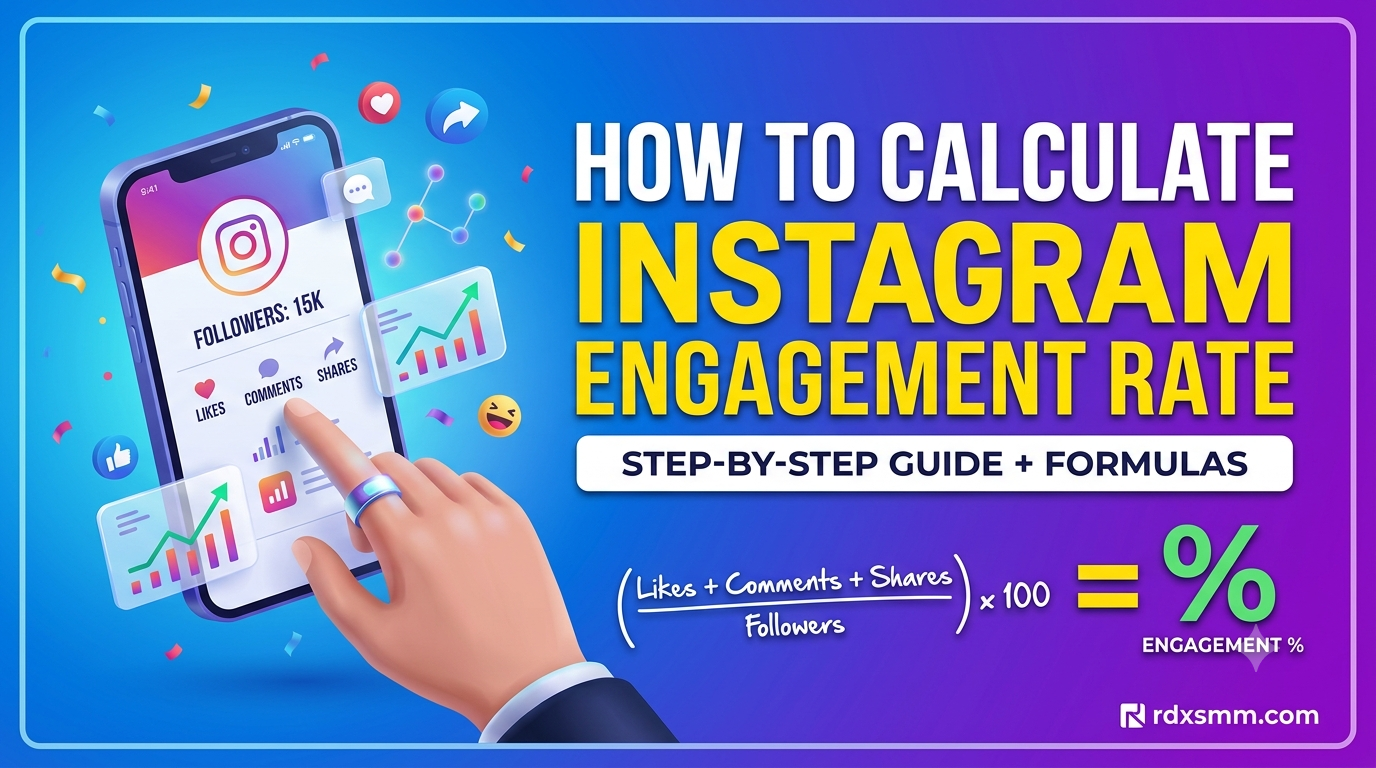
How to Calculate Instagram Engagement Rate: Formula, Examples & Complete Guide
If you want to understand whether your Instagram content is actually performing well, follower count alone isn't enough. An account can have thousands of followers but receive very little interaction, while a smaller account can have a highly active audience.
That's where Instagram engagement rate becomes important.
Engagement rate helps you understand how strongly people interact with your content through actions such as likes, comments, saves and shares. Depending on what you're measuring, you can calculate engagement rate using your followers, reach, impressions or views as the denominator.
In this guide, we'll explain how to calculate Instagram engagement rate, which formula to use, real examples, what the percentage means, common mistakes, and practical ways to improve engagement.
What Is Instagram Engagement Rate?
Instagram engagement rate is a percentage that measures how much people interact with your content compared with the size of your audience or the number of people who actually saw the content.
Common engagement actions include:
- Likes
- Comments
- Saves
- Shares
- Other measurable interactions, depending on the reporting method
A commonly used follower-based formula is:
Instagram Engagement Rate = (Total Engagements ÷ Total Followers) × 100
For content-performance analysis, a reach-based formula can be more informative:
Engagement Rate by Reach = (Total Engagements ÷ Reach) × 100
The best formula depends on what you're trying to measure.
Why Is Instagram Engagement Rate Important?
Follower count tells you the size of an account.
Engagement rate tells you more about how actively the audience interacts with its content.
For example, imagine two accounts:
Account A
- 20,000 followers
- 200 interactions
Account B
- 5,000 followers
- 300 interactions
Account A has a larger audience, but Account B may have a more active audience relative to its size.
This is why engagement rate is useful when evaluating:
- Content performance
- Creator accounts
- Influencer campaigns
- Brand accounts
- Instagram marketing strategies
- Audience quality
- Different content formats
However, engagement rate should never be viewed in isolation. Industry, account size, content format and measurement method can all affect the result.
How to Calculate Instagram Engagement Rate
There are several legitimate ways to calculate Instagram engagement rate.
The two most useful methods for everyday Instagram analysis are:
- Engagement rate by followers
- Engagement rate by reach
Let's look at both.
Method 1: Engagement Rate by Followers
This is one of the simplest ways to calculate engagement.
Formula
Engagement Rate = (Likes + Comments + Saves + Shares) ÷ Followers × 100
Example
Suppose an Instagram account has:
- 10,000 followers
- 500 likes
- 50 comments
- 30 saves
- 20 shares
First, calculate total engagements:
500 + 50 + 30 + 20 = 600
Now divide by followers:
600 ÷ 10,000 = 0.06
Multiply by 100:
0.06 × 100 = 6%
So the engagement rate is:
6%
This method is useful for creating a simple, comparable follower-based metric. Current marketing resources commonly use this type of calculation when comparing accounts or published benchmarks.
Method 2: Engagement Rate by Reach
Follower count doesn't tell you how many people actually saw a particular post.
For example, an account may have 20,000 followers, but a particular Reel could reach 50,000 accounts.
That's why reach-based engagement rate can be especially useful for evaluating individual content.
Formula
Engagement Rate by Reach = (Total Engagements ÷ Total Reach) × 100
Example
Imagine a Reel receives:
- 700 likes
- 60 comments
- 80 saves
- 40 shares
- 25,000 accounts reached
Total engagements:
700 + 60 + 80 + 40 = 880
Now:
880 ÷ 25,000 × 100 = 3.52%
The Reel's engagement rate by reach is therefore:
3.52%
Reach-based measurement can be particularly useful when evaluating content that reaches people beyond your existing followers.
Which Instagram Engagement Rate Formula Should You Use?
There isn't one formula that is perfect for every situation.
| Formula | Best used for |
|---|---|
| Engagement ÷ Followers | Comparing accounts or creating a follower-based benchmark |
| Engagement ÷ Reach | Evaluating how content performed among people who saw it |
| Engagement ÷ Impressions | Understanding engagement relative to total displays |
| Engagement ÷ Views | Useful for video-focused analysis |
For your own content, reach-based engagement rate can provide a useful picture of how strongly the people who actually encountered a post interacted with it.
For comparing public accounts where reach isn't available, follower-based calculations are often more practical.
What Counts as Instagram Engagement?
The exact definition can vary depending on the analytics system and formula being used.
Common interactions include:
Likes
Likes show that someone reacted positively to your content.
Comments
Comments generally represent a deeper form of interaction because the user actively responds to the content.
Saves
Saves can indicate that someone found the content useful enough to return to later.
Shares
Shares can help your content reach additional people and are particularly useful for identifying content that audiences want to pass along.
For your own Instagram analytics, use a consistent definition of "engagement" when comparing posts over time.
How to Calculate Average Instagram Engagement Rate
Calculating the rate for one post can be useful, but one post doesn't always represent your overall performance.
Instead, you can analyze several recent posts.
For example, suppose your last five posts have engagement rates of:
- 2.5%
- 3.2%
- 4.1%
- 2.8%
- 3.4%
You can calculate the simple average:
(2.5 + 3.2 + 4.1 + 2.8 + 3.4) ÷ 5
= 16 ÷ 5
= 3.2%
Your average engagement rate would therefore be 3.2%.
For a more representative picture, many marketers recommend examining multiple recent posts rather than relying on one unusually successful or unsuccessful post.
How to Calculate Instagram Engagement Rate for Reels
Reels can reach people who don't follow your account, so follower count may not always be the best denominator for evaluating an individual Reel.
For example:
- Followers: 10,000
- Reel reach: 40,000
- Likes: 900
- Comments: 70
- Saves: 120
- Shares: 110
Total engagements:
900 + 70 + 120 + 110 = 1,200
Reach-based engagement rate:
1,200 ÷ 40,000 × 100 = 3%
So the Reel has a 3% engagement rate by reach.
This tells you how strongly the content performed among the accounts it reached, rather than assuming all 10,000 followers saw the Reel.
What Is a Good Instagram Engagement Rate?
There is no universal percentage that automatically means an Instagram account is performing well.
Different sources report different benchmarks, and results vary according to:
- Follower count
- Industry
- Content format
- Audience
- Account type
- Measurement formula
- Whether the calculation uses followers, reach, impressions or views
For example, current industry resources commonly describe 1%–5% as a broad range, while noting that meaningful comparisons should be made against similar accounts and industries.
Instead of asking only:
"Is my engagement rate good?"
Ask:
"Is my engagement rate improving compared with my previous content and relevant competitors?"
That gives you a much more useful benchmark.
Why Small Instagram Accounts Can Have Higher Engagement Rates
Smaller accounts often have closer relationships with their audiences.
A creator with 2,000 highly interested followers may receive proportionally more interactions than a large account with hundreds of thousands of followers.
This doesn't mean that smaller accounts are automatically better.
It simply means that follower size needs to be considered when comparing engagement rates.
A fair comparison should consider accounts with similar:
- Audience size
- Industry
- Content format
- Audience location
- Content type
Instagram Engagement Rate vs Follower Count
Follower count and engagement rate measure different things.
Follower count measures:
How many people follow the account.
Engagement rate measures:
How actively the audience interacts with the content relative to the chosen denominator.
For example:
Account A
100,000 followers
1% engagement rate
Account B
10,000 followers
5% engagement rate
Account A has a much larger audience.
Account B has a much higher engagement rate.
Both metrics can be useful depending on your objective.
How to Improve Instagram Engagement Rate
If your engagement rate is lower than you'd like, focus on improving the content and audience experience rather than simply chasing a larger follower number.
1. Create More Useful Content
Educational and problem-solving content can encourage people to save and share posts.
Examples:
- Tutorials
- Checklists
- Step-by-step guides
- Mistakes to avoid
- Tips
- Industry information
2. Improve Your Reels Hooks
The beginning of a Reel should quickly communicate why someone should continue watching.
Instead of a long introduction, get to the main idea quickly.
3. Ask Relevant Questions
Questions can encourage genuine discussion.
For example:
"Which Instagram feature do you use most?"
Avoid asking for comments when the question has nothing to do with the content.
4. Create Shareable Content
Think about what your audience would send to a friend.
Useful, entertaining or relatable content can naturally generate shares.
5. Encourage Saves
Create content that people may want to reference later.
Examples include:
- Tutorials
- Lists
- Checklists
- Tips
- Educational carousels
6. Respond to Your Audience
Reply to genuine comments and questions.
Building conversations can help turn passive followers into an active community.
7. Study Your Analytics
Look for patterns.
Ask:
- Which posts receive the most saves?
- Which Reels get the most shares?
- Which topics generate comments?
- Which posts lead to profile visits?
- Which formats consistently perform well?
Then create more content around what your audience responds to.
Common Instagram Engagement Rate Mistakes
Mistake 1: Looking Only at Likes
Likes are useful, but they aren't the entire picture.
Comments, saves and shares can provide additional information about how people interact with your content.
Mistake 2: Comparing Completely Different Accounts
A 5,000-follower creator and a 500,000-follower brand may have very different engagement patterns.
Compare similar accounts whenever possible.
Mistake 3: Using Different Formulas Every Time
If you calculate one post using followers and another using reach, the percentages aren't directly comparable.
Choose a method and use it consistently.
Mistake 4: Focusing on One Viral Post
One unusually successful post can distort your understanding of your normal performance.
Look at multiple posts over a longer period.
Mistake 5: Chasing Engagement at Any Cost
The objective isn't simply to increase a percentage.
You want relevant engagement from people who are genuinely interested in your content.
Can an SMM Panel Improve Instagram Engagement Rate?
An SMM panel can provide social media marketing services, but a service number should never be confused with genuine audience interest.
If you're exploring social media marketing services, RdxSMM.com provides an SMM panel where users can review available services and manage orders through the platform.
However, sustainable Instagram performance still depends heavily on your content, audience relevance, consistency and overall marketing strategy.
A useful approach is:
Quality content + genuine audience + consistent publishing + analytics + appropriate promotion
rather than focusing only on increasing visible numbers.
Frequently Asked Questions
What is the formula for Instagram engagement rate?
A common follower-based formula is:
(Total Engagements ÷ Total Followers) × 100
For reach-based analysis:
(Total Engagements ÷ Reach) × 100
The appropriate formula depends on what you want to measure.
Is 5% engagement rate good on Instagram?
A 5% rate can be strong in many contexts, but there is no universal "good" percentage. Compare it with accounts of similar size, industry and content type.
Should I calculate engagement rate using followers or reach?
Use followers when you need a simple account-comparison metric. Use reach when you want to understand how effectively a particular piece of content engaged the people who actually saw it.
Do saves and shares count as engagement?
They can. The exact engagement definition varies by analytics platform and calculation method. For your own content analysis, including meaningful interactions such as saves and shares can provide a broader view of audience response.
Does follower count affect engagement rate?
It can. Engagement rates often vary by account size, so comparing accounts of very different sizes can produce misleading conclusions.
How often should I check Instagram engagement rate?
Checking performance regularly is useful, but avoid judging your strategy based on a single post. Track trends across multiple posts and longer periods.
Can Instagram engagement rate help businesses?
Yes. Engagement rate can help businesses evaluate content performance, understand audience response and compare different content strategies.
Final Thoughts
Instagram engagement rate is one of the most useful metrics for understanding how people respond to your content.
The basic calculation is simple:
Engagement Rate = (Engagements ÷ Followers or Reach) × 100
But the important part isn't just calculating the percentage. You also need to understand which formula you're using, what the number represents, and how it compares with your previous performance.
Track your engagement consistently, analyze your best-performing content, create material your audience genuinely finds useful, and use the data to improve your Instagram strategy.
If you're also looking for social media marketing services, you can explore RdxSMM.com and review the available options for your social media marketing needs.
Build an engaged audience—not just a bigger number.