Instagram Followers vs Engagement: What Matters More?
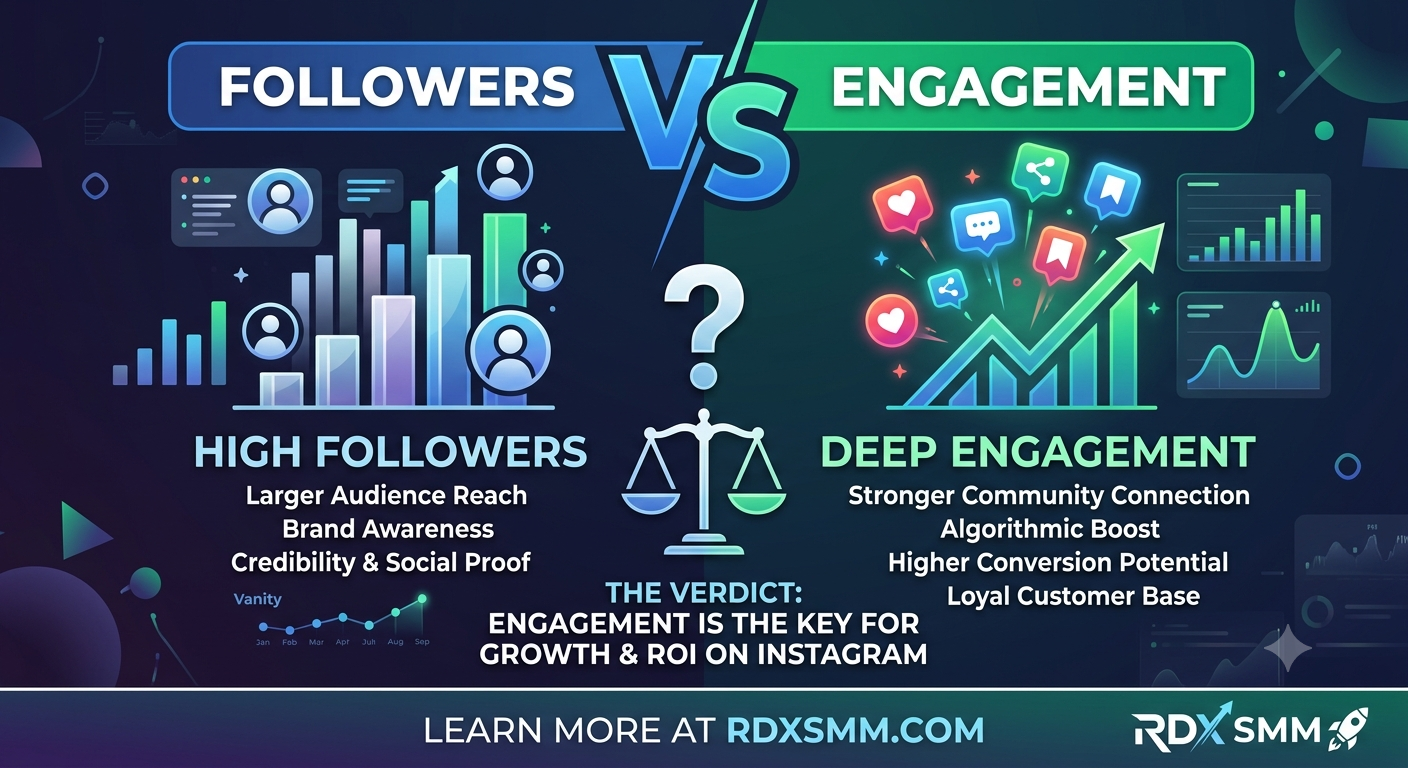
Instagram Followers vs Engagement: What Matters More?
When growing an Instagram account, one question comes up again and again:
Is having more Instagram followers more important, or is high engagement more valuable?
A profile with 100,000 followers can look impressive, but if only a small percentage of those followers interact with its content, the account may not be as valuable as it appears.
On the other hand, a smaller Instagram account with an active audience can generate strong conversations, shares, saves, profile visits, and potential customers.
So, Instagram followers vs engagement—which matters more?
The short answer is: both matter, but engagement and audience quality are generally more useful indicators of an active community than follower count alone.
In this guide, we'll explain the difference between Instagram followers and engagement, how engagement rate works, why audience quality matters, and how you can build a stronger Instagram presence.
What Are Instagram Followers?
Instagram followers are accounts that choose to follow your profile.
Your follower count represents the size of your potential audience.
For example:
- Account A has 1,000 followers.
- Account B has 10,000 followers.
- Account C has 100,000 followers.
At first glance, Account C appears to be the most successful.
However, follower count doesn't tell you how many people actually watch, like, comment on, save, or share the content.
That's why follower count should be considered alongside other Instagram metrics.
What Is Instagram Engagement?
Instagram engagement refers to the actions people take when interacting with your content.
Depending on the content and features available to an account, engagement can include:
- Likes
- Comments
- Shares
- Saves
- Replies
- Profile visits
- Other meaningful interactions
For example, imagine an Instagram post receives:
20,000 views
but only:
50 likes and 2 comments.
Now compare it with another post that receives:
8,000 views
and generates:
600 likes, 80 comments, and 150 shares.
The second post may indicate a much stronger response from its audience despite receiving fewer views.
Instagram Followers vs Engagement: What's the Difference?
The easiest way to understand the difference is:
Followers = potential audience size
Engagement = audience interaction
A large follower count tells you how many accounts follow a profile.
Engagement tells you how actively people interact with its content.
This is why two accounts with the same number of followers can have completely different levels of influence.
Why Instagram Followers Matter
Although engagement is important, followers shouldn't be ignored.
A larger relevant audience can provide several advantages.
1. Larger Potential Reach
More relevant followers give you a larger potential audience for future content.
However, having more followers doesn't guarantee that every follower will see or interact with every post.
2. Social Proof
A substantial follower count can make a profile appear established.
For businesses and creators, this can influence how new visitors perceive an account.
But social proof is strongest when the audience is genuine and the account also demonstrates meaningful activity.
3. Brand Awareness
Businesses can use Instagram to introduce products, services, ideas, and content to an audience.
A larger relevant audience can increase the number of people who potentially discover your brand.
4. Long-Term Audience Building
Followers can become a recurring audience for future content.
The important word here is relevant.
10,000 people interested in your niche can be considerably more useful than 100,000 people who have no interest in your content.
Why Instagram Engagement Matters
Engagement provides additional information about how people respond to your content.
1. It Shows Audience Interest
When people regularly comment, share, save, or interact with your content, it can indicate that your posts are resonating with them.
2. It Helps You Understand Your Audience
High-performing posts can reveal what topics your audience finds useful or interesting.
For example, suppose you publish:
- Educational content
- Entertainment content
- Product content
- Behind-the-scenes content
If educational posts consistently generate more saves and shares, that information can help shape your future content strategy.
3. Engagement Can Support Community Building
Comments, replies, shares, and conversations can turn an audience into a community.
This is particularly important for:
- Creators
- Influencers
- Businesses
- Personal brands
- Online communities
4. Engagement Can Be More Useful Than Vanity Metrics
A follower number is easy to display, but it doesn't explain everything about an account.
Looking at multiple metrics gives you a much clearer picture of performance.
What Is Instagram Engagement Rate?
Engagement rate is a way of measuring interactions relative to an audience or another selected metric.
One commonly used simplified formula is:
Engagement Rate = Engagements ÷ Followers × 100
For example, suppose an account has:
10,000 followers
and a post receives:
500 engagements
A simplified follower-based calculation would be:
500 ÷ 10,000 × 100 = 5%
However, different tools and marketers calculate engagement rate differently.
Some may use reach, impressions, views, or other metrics as the denominator.
Therefore, when comparing engagement rates, make sure you're comparing the same calculation method.
Is a High Follower Count Enough?
No.
A high follower count by itself doesn't guarantee a successful Instagram account.
Consider these two hypothetical profiles:
Profile A
- 100,000 followers
- Very few comments
- Few shares
- Few saves
- Low audience interaction
Profile B
- 10,000 followers
- Strong comments
- Frequent shares
- High saves
- Active community
Profile A has a much larger audience, but Profile B may have a more active and relevant community.
This is why quality and relevance matter alongside quantity.
Is Engagement More Important Than Followers?
For many creators and businesses, engagement is more useful than follower count when evaluating audience activity.
But that doesn't mean followers are unimportant.
Think of Instagram growth as a combination:
Relevant followers + valuable content + engagement + consistency
If you only focus on followers, you may build a large audience that doesn't interact.
If you only focus on engagement without growing your audience, your overall reach may remain limited.
The best strategy is to work on both.
How to Increase Instagram Followers and Engagement
Instead of choosing between followers and engagement, build a strategy that improves both.
1. Create Useful Content
Ask:
"What does my audience gain from this post?"
Useful content could include:
- Tutorials
- Tips
- Checklists
- Industry information
- Educational carousels
- Product demonstrations
- Entertaining videos
- Problem-solving content
2. Focus on Reels
Short-form video can be an important part of an Instagram growth strategy.
Experiment with:
- Educational Reels
- Tutorials
- Quick tips
- Behind-the-scenes videos
- Product videos
- Storytelling
- Niche-specific content
Focus on creating a strong opening that immediately communicates why someone should continue watching.
3. Encourage Genuine Conversations
Instead of using generic engagement-bait, create content that naturally invites discussion.
For example:
"Which Instagram feature do you find most useful?"
A relevant question can encourage people to share their experiences.
4. Use Instagram Stories
Stories can help maintain relationships with existing followers.
Try:
- Polls
- Questions
- Quizzes
- Behind-the-scenes content
- Announcements
- Short tips
5. Study Your Analytics
Look beyond your follower count.
Track metrics such as:
- Reach
- Views
- Likes
- Comments
- Shares
- Saves
- Profile visits
- Follows
Then identify patterns.
If certain topics consistently generate more shares and saves, create additional content around those topics.
Followers vs Engagement for Businesses
For businesses, the answer becomes even more nuanced.
Suppose an online store has:
50,000 followers
but almost nobody clicks its links, asks questions, or interacts with product content.
Another store has:
8,000 followers
and receives regular comments, product inquiries, shares, and website visits.
The second account could potentially have a more valuable audience.
Businesses should therefore measure metrics that connect social media activity with actual business objectives.
Depending on the business, useful measurements may include:
- Website visits
- Leads
- Product inquiries
- Sales
- Content shares
- Saves
- Profile visits
- Audience growth
- Engagement
Followers vs Engagement for Influencers
Influencers also need to look beyond follower count.
Brands may consider factors such as:
- Audience relevance
- Engagement
- Content quality
- Niche
- Audience demographics
- Consistency
- Previous campaign performance
A smaller creator with a highly relevant audience can sometimes be a better fit for a campaign than a much larger account whose audience isn't relevant to the brand.
Does More Engagement Guarantee Instagram Growth?
Not necessarily.
Engagement is only one part of Instagram performance.
Your content can receive strong engagement from an existing audience without reaching many new people.
That's why you should consider both:
Audience retention
and
Audience discovery.
Content that keeps existing followers interested is valuable, while content that attracts new relevant viewers can help expand your audience.
A balanced content strategy should aim for both.
Should You Focus on Followers or Engagement First?
If you're starting from a small account, focus first on content quality and audience relevance.
Don't obsess over a specific follower number.
Instead:
- Define your niche.
- Understand your target audience.
- Create useful content.
- Publish consistently.
- Experiment with Reels and other formats.
- Respond to your audience.
- Analyze performance.
- Repeat what works.
As your content improves, you can work toward increasing both followers and engagement.
Can an SMM Panel Help With Instagram Marketing?
SMM panels such as RdxSMM.com can provide access to various social media marketing services through a centralized platform.
However, an SMM service should not be considered a replacement for a genuine content and audience-building strategy.
For long-term Instagram growth, combine your marketing efforts with:
- High-quality content
- Consistent publishing
- Audience research
- Genuine engagement
- Analytics
- Relevant promotion
If you're exploring social media marketing services, you can visit RdxSMM.com to see the services and options available on the platform.
Frequently Asked Questions
Are Instagram followers more important than engagement?
Neither metric tells the complete story. Followers indicate audience size, while engagement provides information about audience interaction. For many accounts, a relevant and engaged audience is more valuable than a large but inactive follower count.
What is a good Instagram engagement rate?
There isn't one universal engagement rate that is considered "good" for every account. Results vary by niche, audience size, content type, calculation method, and other factors.
Can you have many followers but low engagement?
Yes. An account can have a large follower count while receiving relatively little interaction. This is one reason follower count shouldn't be used as the only measure of Instagram performance.
How can I increase Instagram engagement?
Create content your audience finds useful or entertaining, use relevant formats, encourage genuine discussion, interact with your community, and study your analytics to understand which content performs best.
How can I increase Instagram followers?
Optimize your profile, create valuable content, use Reels strategically, publish consistently, collaborate with relevant creators, and make content that people want to share.
Should businesses focus on followers or engagement?
Businesses should monitor both, but they should also track metrics connected to their actual goals, such as website visits, leads, inquiries, conversions, saves, shares, and customer interactions.
Final Verdict: Followers or Engagement?
So, Instagram followers vs engagement—which matters more?
The best answer is neither should be viewed in isolation.
Followers tell you about the potential size of your audience.
Engagement tells you more about how that audience interacts with your content.
A strong Instagram account aims for:
Relevant followers + meaningful engagement + valuable content + consistent growth.
Instead of chasing the biggest possible follower number, focus on attracting the right people and giving them reasons to keep following, watching, sharing, and interacting with your content.
And if you're looking for an SMM platform to explore social media marketing services, visit RdxSMM.com and choose services according to your marketing goals.
Build the audience. Create the value. Measure the engagement. Then scale what works.