Instagram Story vs Reel: Which Gets More Reach?
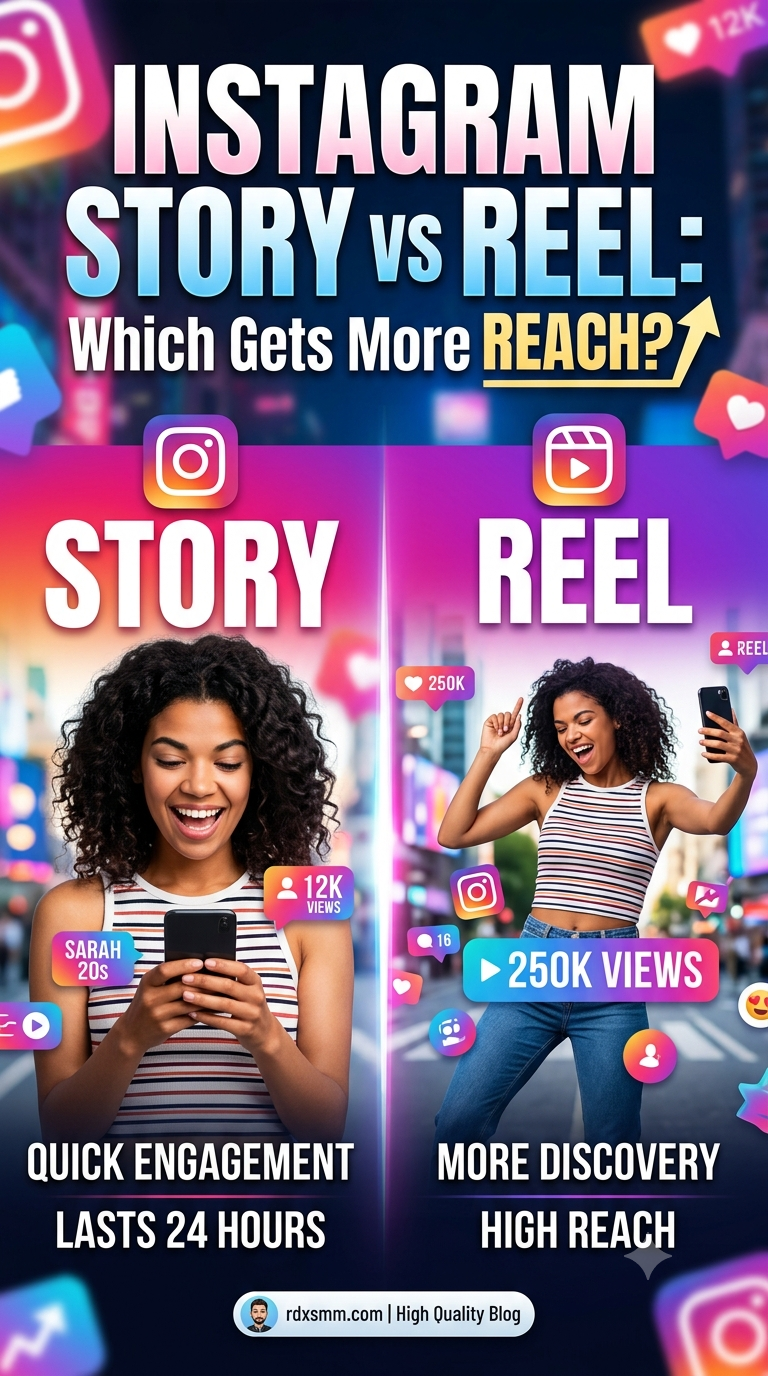
Instagram Story vs Reel: Which Gets More Reach?
If you are trying to grow on Instagram, one question comes up again and again:
Instagram Story vs Reel — which one gets more reach?
Both Instagram Stories and Reels are important content formats, but they serve different purposes. Reels are generally better suited for reaching people who don't already follow you, while Stories are particularly useful for engaging your existing audience and keeping your profile active.
That doesn't mean you should choose only one.
A successful Instagram strategy can use Reels for discovery and Stories for relationship-building.
In this guide, we'll compare Instagram Stories and Reels, explain how their reach differs, discuss when you should use each format, and show you how to build a practical Instagram content strategy.
Instagram Story vs Reel: Quick Comparison
| Feature | Instagram Reels | Instagram Stories |
|---|---|---|
| Main purpose | Discovery & content reach | Audience engagement |
| Typical lifespan | Can continue receiving views after publishing | Usually disappears after 24 hours |
| Best for | Reaching new audiences | Connecting with existing followers |
| Content style | Short-form video | Photos, videos, text & interactive content |
| Discovery potential | Generally higher | Generally more follower-focused |
| Engagement tools | Likes, comments, shares, saves | Replies, polls, questions, reactions |
| Best strategy | Attract new viewers | Keep followers engaged |
The most important point is that reach isn't the only metric that matters.
A Reel might reach thousands of people but generate very few profile visits or followers. A Story might reach fewer people but produce significantly more replies, clicks, or conversations.
What Is Instagram Reach?
Before comparing Stories and Reels, it's important to understand what "reach" actually means.
Instagram reach generally refers to the number of unique accounts that have seen your content.
This is different from impressions or views.
For example, if 1,000 different people see your content, your reach can be around 1,000. If some of those people view the content multiple times, the number of impressions or views can be higher.
For creators and businesses, reach is useful because it tells you how many unique people your content is getting in front of.
However, reach alone doesn't determine whether a post was successful.
You should also consider:
- Shares
- Saves
- Comments
- Profile visits
- Follows
- Website clicks
- Replies
- Conversions
Do Instagram Reels Get More Reach Than Stories?
For many accounts, Reels have greater potential for reaching non-followers because short-form video can be recommended beyond your existing audience.
Stories, on the other hand, are primarily useful for communicating with people who already follow or regularly interact with your account.
That's why comparing the two formats only by raw reach can be misleading.
Think of it this way:
Reels = Discovery
Stories = Relationship
If your goal is to introduce your account to new people, Reels can be a powerful format.
If your goal is to stay connected with your existing audience, Stories can be extremely useful.
Why Reels Can Reach More People
One of the biggest advantages of Reels is that they can be discovered by people who don't follow your account.
A useful or entertaining Reel can potentially appear in recommendation surfaces and reach audiences outside your existing follower base.
This creates an opportunity for smaller accounts to get discovered.
Example
Imagine you run a social media marketing account.
You publish a Reel titled:
"5 Instagram mistakes that are reducing your reach."
Someone who doesn't follow you may discover the Reel, watch it, visit your profile, and eventually follow your account.
That discovery journey is one reason Reels can be valuable for growth.
Why Instagram Stories Are Still Important
If Reels can potentially reach more people, why should you continue using Stories?
Because reach isn't the only purpose of social media content.
Stories are excellent for maintaining relationships with your existing audience.
You can use them to:
- Ask questions
- Run polls
- Share updates
- Show behind-the-scenes content
- Promote new posts
- Share announcements
- Collect feedback
- Answer common questions
- Create conversations
- Direct followers toward products or services
Stories can make your account feel more active and personal.
Instagram Reels vs Stories for New Followers
If your primary objective is getting discovered by new people, Reels are generally the stronger format to prioritize.
Create Reels around topics your target audience actually searches for or cares about.
For example:
- Instagram tips
- Marketing tutorials
- Quick how-to guides
- Common mistakes
- Educational content
- Product demonstrations
- Industry tips
- Entertaining niche-specific content
The key is not simply producing more Reels.
Create Reels that give viewers a reason to stop scrolling.
Instagram Stories vs Reels for Engagement
Stories can be particularly effective for direct interaction with your existing audience.
Instagram provides interactive Story features such as:
- Polls
- Questions
- Emoji sliders
- Replies
- Link stickers
- Quizzes
These features can turn passive viewers into active participants.
For example, a social media account could post:
"Which content format do you use most?"
Then provide two poll options:
Reels
Stories
This creates a simple interaction while also providing information about your audience.
Which Is Better for Instagram Growth?
The answer depends on what you mean by "growth."
If you want more discovery:
Prioritize Reels.
If you want stronger relationships:
Prioritize Stories.
If you want both:
Use Reels and Stories together.
This combined strategy is usually more useful than trying to decide which format is universally better.
The Best Strategy: Use Reels + Stories Together
Instead of treating Reels and Stories as competitors, use them as parts of the same content funnel.
Here's a simple example.
Step 1: Publish a Reel
Create a useful Reel around a topic your audience cares about.
Example:
"3 reasons your Instagram Reels aren't getting views."
Step 2: Share the Reel to Stories
Tell your existing followers that you've published new content.
Step 3: Add a Story Poll
Ask:
"Are your Reels getting fewer views lately?"
Give viewers two options.
Step 4: Continue the Conversation
Use the responses to create your next Reel.
This creates a cycle:
Reel → Discovery → Profile → Follow → Story → Engagement → New Content
How to Get More Reach From Instagram Reels
If Reels are part of your growth strategy, focus on the quality of the content rather than simply increasing your posting frequency.
1. Start With a Strong Hook
The opening seconds should make the viewer understand why they should continue watching.
Instead of:
"Hello guys, welcome back..."
Try:
"Your Instagram Reels might be losing viewers because of these three mistakes."
The second opening immediately presents a problem.
2. Keep the Topic Clear
Don't try to explain ten unrelated subjects in one short video.
Choose one idea and explain it clearly.
3. Make the Content Useful
People are more likely to share or save content when it provides practical value.
Examples:
- Tutorials
- Checklists
- Tips
- Mistakes
- Explanations
- Comparisons
4. Use Clear Text
Many people watch social media videos without sound.
Make important information understandable through on-screen text where appropriate.
5. Encourage Natural Interaction
Instead of begging viewers to "LIKE COMMENT SHARE FOLLOW," provide a reason to interact.
For example:
"Which Instagram feature should I explain next?"
That's more natural and useful.
How to Get More Engagement From Instagram Stories
Stories work best when they aren't simply a stream of promotional messages.
Try mixing different types of content.
Educational Stories
Share quick tips or useful facts.
Interactive Stories
Use polls, questions and other interactive features.
Behind-the-Scenes Stories
Show how your content, product or business works.
Community Stories
Share customer feedback, user-generated content or relevant community updates where appropriate.
Promotional Stories
Promote your products or services, but balance promotional content with useful or entertaining posts.
How Often Should You Post Reels and Stories?
There is no universal number that guarantees growth.
Your ideal posting frequency depends on:
- Your niche
- Your audience
- Your available time
- Your content quality
- Your account size
- Your content strategy
A sustainable schedule is usually better than publishing a large amount of low-quality content.
For example, you could experiment with:
Reels: several times per week
Stories: regularly throughout the week
Then review your analytics and adjust the schedule according to your results.
What Should You Measure?
Don't judge your Instagram strategy only by follower count.
For Reels, pay attention to:
- Reach
- Views
- Watch behavior
- Shares
- Saves
- Comments
- Profile visits
- Follows
For Stories, consider:
- Reach
- Replies
- Sticker interactions
- Link clicks
- Profile activity
- Exits
- Completion behavior
Your most valuable metric depends on your objective.
If you're trying to build awareness, reach can be important.
If you're trying to build a community, replies and interactions may matter more.
If you're promoting a business, clicks and conversions can be more meaningful.
Common Mistakes When Comparing Reels and Stories
Mistake 1: Comparing only views
A Reel and Story have different purposes, so comparing views alone doesn't tell the whole story.
Mistake 2: Ignoring your existing audience
Stories can be valuable even when their reach is smaller because they help maintain relationships with followers.
Mistake 3: Posting Reels without a strategy
More videos don't automatically mean better growth.
Mistake 4: Using Stories only for promotions
If every Story is an advertisement, followers may stop paying attention.
Mistake 5: Ignoring analytics
Your own account data is often more useful than generic advice.
Can an SMM Panel Help With Instagram Marketing?
SMM panels such as RdxSMM.com provide access to social media marketing services through an online platform.
However, an SMM panel should not be considered a replacement for a strong content strategy.
If your objective is long-term Instagram growth, focus on:
Useful content + consistent publishing + audience engagement + analytics + appropriate promotion.
You can explore the available social media marketing services at RdxSMM.com while continuing to build your Instagram audience through genuine content and community engagement.
Instagram Story vs Reel: Which One Should You Use?
There isn't one universal winner.
If your main goal is reaching new audiences, Reels are usually the better format to prioritize.
If your main goal is engaging your existing followers, Stories are extremely useful.
For the strongest overall strategy, use both.
A simple strategy:
Reels → Reach new people
Profile → Convert visitors into followers
Stories → Build relationships
Analytics → Understand what works
New content → Repeat and improve
Frequently Asked Questions
Are Reels better than Stories for reach?
Reels generally have greater potential to reach people outside your existing follower base, while Stories are particularly useful for your existing audience. Actual performance varies by account and content.
Do Instagram Stories increase followers?
Stories can support follower growth indirectly by keeping your existing audience engaged and encouraging profile activity, but Reels are generally more suitable for reaching new audiences.
Should I post Reels every day?
You don't necessarily need to post every day. A consistent schedule that allows you to maintain quality is more sustainable.
Should I use both Reels and Stories?
Yes. Reels can help with discovery, while Stories can help you maintain relationships and engagement with your existing audience.
Why are my Reels getting low reach?
Low reach can have many possible causes, including topic selection, content quality, audience interest, competition, viewer retention and how people respond to the content. Review your analytics rather than assuming there is one single cause.
Which is better for a business: Stories or Reels?
Both can be useful. Reels can help introduce your business to new audiences, while Stories can help communicate with existing followers, showcase products, answer questions and encourage interaction.
Final Verdict
So, Instagram Story vs Reel: which gets more reach?
For discovering new audiences, Reels generally have the stronger opportunity.
For engaging people who already follow you, Stories are often more useful.
The smartest approach isn't choosing one and ignoring the other.
Use Reels to attract attention, Stories to build relationships, and Instagram analytics to understand what your audience responds to.
If you're also looking for social media marketing services, RdxSMM.com can be used as part of your broader social media marketing workflow.
Ultimately, sustainable Instagram growth comes from creating content that people actually want to watch, save, share and engage with—not simply chasing a bigger number on your profile.