What Does Drip Feed Mean in an SMM Panel? Complete Guide
What Does Drip Feed Mean in an SMM Panel? Complete Guide
If you have ever used an SMM panel, you may have noticed an option called Drip Feed while placing an order. For beginners, the term can sound complicated, but the concept is actually quite simple.
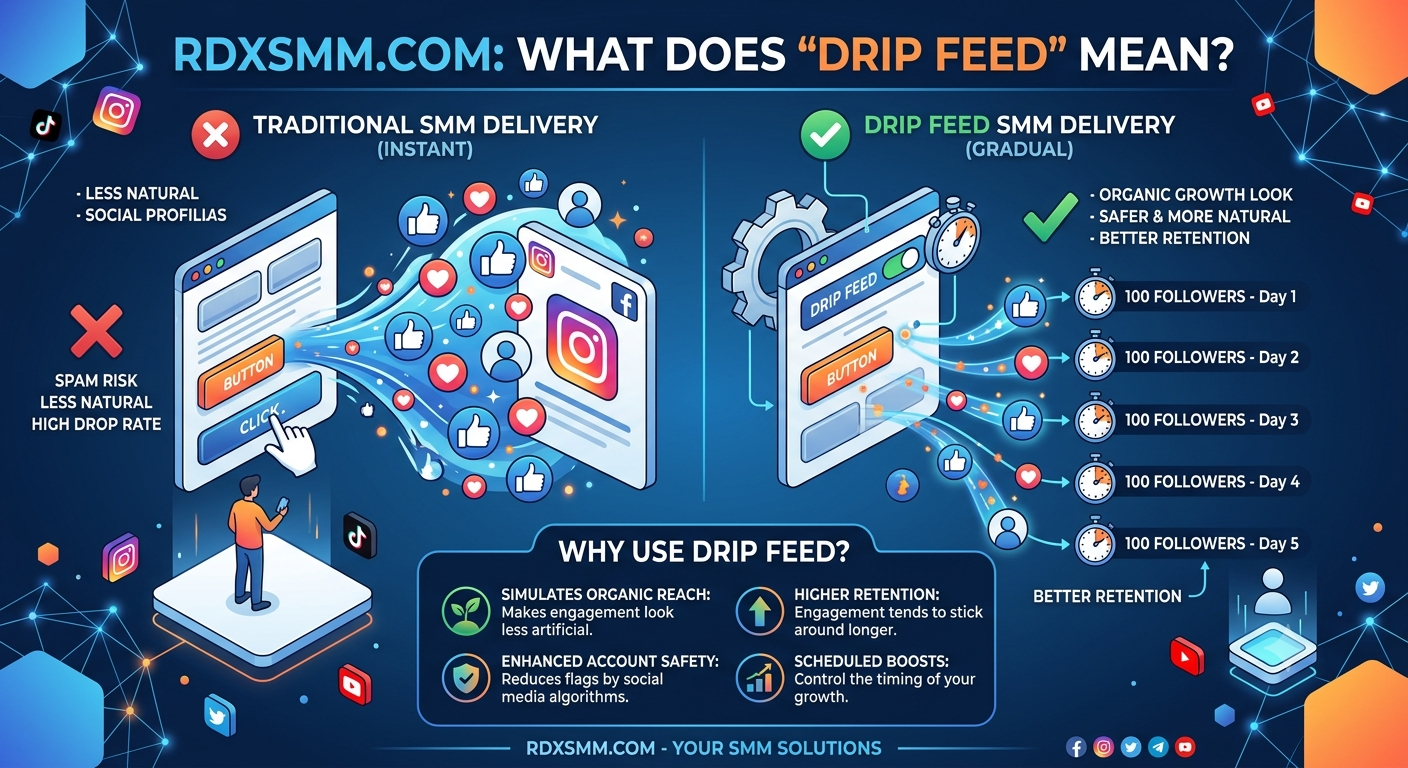
Drip Feed means delivering an SMM order gradually in multiple scheduled batches instead of delivering the entire quantity at once.
For example, instead of delivering 1,000 units in a single batch, a drip-feed setup could divide the order into 10 runs of 100 units each, with a selected interval between the runs.
This guide explains what drip feed means, how it works, what “runs” and “interval” mean, the difference between drip feed and instant delivery, and what you should check before placing a drip-feed order.
What Is Drip Feed in an SMM Panel?
In an SMM panel, Drip Feed is a scheduling feature that distributes an order over time.
A normal order may be submitted for processing as one quantity. With drip feed, that quantity is divided into multiple scheduled deliveries.
For example:
Standard delivery:
1,000 views → delivered as one order
Drip-feed delivery:
100 views → Run 1
100 views → Run 2
100 views → Run 3
...
100 views → Run 10
The exact delivery speed depends on the SMM panel, the selected service, and the provider behind that service. Some panels allow users to specify the number of runs and the interval between them.
How Does Drip Feed Work?
A typical drip-feed system uses three important settings:
1. Quantity
Quantity refers to the amount delivered during each run on many SMM panels.
For example:
100 units per run
However, this is important: SMM panels don't all define the quantity field in exactly the same way. Some systems may treat quantity as the total campaign amount rather than the amount per run.
Always check the order form and total-cost preview before submitting an order.
2. Runs
A run is one scheduled delivery.
For example:
- Quantity per run: 100
- Runs: 10
If the panel uses quantity-per-run settings, the planned total would be:
100 × 10 = 1,000 units
3. Interval
The interval determines how much time passes between scheduled runs.
For example:
- 60 minutes
- 6 hours
- 12 hours
- 24 hours
The available interval depends on the service and panel.
Drip Feed Example
Let's take a simple example.
Suppose you want 1,000 Instagram views.
You could configure a supported service like this:
| Setting | Example |
|---|---|
| Quantity per run | 100 |
| Runs | 10 |
| Interval | 6 hours |
| Planned total | 1,000 |
The system would schedule multiple deliveries instead of attempting to process the entire amount in one batch.
This gives you control over the timing of delivery, rather than changing the underlying service itself.
Why Do SMM Panels Offer Drip Feed?
The main reason for drip feed is pacing.
Some users don't want a large order delivered immediately. They may prefer a campaign spread over several hours or days.
Drip feed can therefore be useful when:
- You want scheduled delivery
- You are running a longer promotional campaign
- You want to divide a large order into smaller batches
- You need more control over delivery timing
- Your campaign is planned around a content schedule
It is best to think of drip feed as a delivery-scheduling tool, not as a guarantee of better engagement.
Drip Feed vs Instant Delivery
The biggest difference is how the order is delivered.
| Feature | Instant/Standard | Drip Feed |
|---|---|---|
| Delivery pattern | Usually faster or provider-dependent | Scheduled batches |
| Multiple runs | Usually no | Yes |
| Timing control | Limited | Greater |
| Suitable for | Quick campaigns | Gradual campaigns |
| Total quantity | Depends on order | Depends on configuration |
| Delivery guarantee | Depends on service | Depends on service |
Drip feed doesn't automatically make a service higher quality. The underlying provider, service specifications, retention, refill policy, and delivery performance still matter.
Does Drip Feed Make Growth Organic?
This is one of the most common questions about drip feed.
No. Drip feed does not turn an SMM service into organic growth.
It changes when the service is delivered.
For example, if an SMM service delivers 1,000 units, changing the schedule from one delivery to several scheduled deliveries doesn't change the fundamental nature or source of that service.
Drip feed can create a more gradual delivery pattern, but it does not guarantee:
- Organic followers
- Genuine engagement
- Better retention
- Algorithmic growth
- Account safety
- Real customers
- Platform approval
Therefore, don't treat the word “Drip Feed” as a guarantee of authenticity or safety.
What Is the Difference Between Drip Feed and Refill?
These two terms are often confused.
Drip Feed
Controls how the original order is delivered.
It answers:
“How should my order be distributed over time?”
Refill
Concerns replacement after a drop, when the particular service includes a refill guarantee.
It answers:
“What happens if eligible delivered units decrease during the provider's refill period?”
Therefore:
Drip Feed ≠ Refill
They solve different problems and may sometimes be available on the same service.
Is Drip Feed Available for Every SMM Service?
No.
Whether you can use drip feed depends on:
- The SMM panel
- The specific service
- The upstream provider
- Minimum and maximum limits
- Available scheduling options
- API support
Some services may support drip feed while others may only support standard delivery.
Before placing an order, check whether the service listing actually provides drip-feed settings.
How to Choose a Drip Feed Service
If you're comparing SMM panel services, don't look at drip feed alone.
Check the complete service description.
1. Check the minimum quantity
A service may require a particular minimum order.
2. Check the maximum quantity
Large campaigns may be restricted by the provider's maximum order limit.
3. Check the delivery information
Look for:
- Start time
- Average speed
- Estimated completion
- Drip-feed availability
Remember that advertised delivery times are estimates and can vary.
4. Check refill information
If a service offers a refill guarantee, understand exactly:
- How long the guarantee lasts
- What is covered
- What isn't covered
- How refill requests are handled
5. Check cancellation rules
Some scheduled orders may have different cancellation conditions once individual runs have started.
6. Check the total cost
Always confirm the final quantity and price before submitting.
Common Drip Feed Mistakes
Mistake 1: Confusing Runs With Total Quantity
Suppose a panel uses quantity-per-run settings:
100 × 20 runs = 2,000 total units
Don't accidentally assume that “100” means the entire campaign.
Always check the panel's calculation.
Mistake 2: Choosing an Interval Without Checking the Total Duration
More runs and longer intervals can significantly extend the campaign.
For example, a campaign with multiple scheduled runs may take considerably longer than a standard order.
Mistake 3: Assuming Drip Feed Guarantees Safety
Drip feed only controls delivery scheduling. It doesn't guarantee that an account or content will avoid platform restrictions.
Mistake 4: Ignoring the Service Description
Every provider can have different limits and conditions.
Read the service details before ordering.
Mistake 5: Ordering More Than You Actually Need
A larger order isn't automatically a better marketing strategy.
Consider your content, audience, campaign objectives, and budget before deciding on quantity.
When Should You Use Drip Feed?
Drip feed can make sense when timing is more important than immediate delivery.
For example, an agency may be managing a campaign over several days and want its scheduled SMM orders distributed according to that campaign.
It can also be useful when a user simply prefers a staged delivery rather than a single large batch.
However, if your objective is time-sensitive promotion and the service is designed for fast delivery, standard delivery may be more appropriate.
The right option depends on the campaign and the specific service.
Can Drip Feed Be Used for Instagram?
Some Instagram services on SMM panels support drip-feed scheduling.
Depending on the provider, this can include services related to:
- Instagram followers
- Instagram likes
- Instagram views
- Other eligible social media services
Availability and settings vary by service, so check the individual service description before ordering.
Drip Feed for Agencies and Resellers
Drip feed can also be useful for SMM agencies and resellers managing campaigns for clients.
Instead of treating every campaign as an immediate bulk order, a reseller can use scheduled delivery where the selected service supports it.
For agencies, important things to monitor include:
- Client requirements
- Campaign duration
- Total quantity
- Number of runs
- Interval
- Service limits
- Provider performance
- Refill conditions
- Order status
Good campaign management is about more than simply choosing the cheapest service.
How RdxSMM.com Can Help
If you're looking for an SMM panel where you can browse social media marketing services, RdxSMM.com provides a platform for users to explore available services and place SMM orders.
When using any SMM panel, always review the individual service description before placing an order. Check the service's limits, delivery information, refill terms, and whether drip-feed functionality is actually supported.
The goal should be choosing a service that matches your campaign requirements rather than choosing a service solely because it has the lowest price.
Frequently Asked Questions
What does drip feed mean in an SMM panel?
Drip feed is a scheduling feature that divides an eligible SMM order into multiple deliveries over a selected period instead of processing the entire quantity at once.
What are runs in drip feed?
Runs are the number of scheduled delivery cycles. For example, 10 runs means the system is scheduled to execute the delivery 10 times, subject to the panel and provider's rules.
What is the interval in drip feed?
The interval is the amount of time between scheduled runs, such as 60 minutes, 6 hours, or 24 hours.
Is drip feed better than instant delivery?
Neither is universally better. Drip feed is useful when you want scheduled delivery, while standard delivery can be more suitable when speed is the priority.
Does drip feed make followers real?
No. Drip feed controls the delivery schedule. It does not determine whether followers or engagement are genuine.
Does drip feed guarantee Instagram safety?
No. A drip-feed schedule cannot guarantee that an account will avoid platform restrictions or other risks.
Does drip feed cost more?
It depends on the individual SMM panel and service. Check the displayed service price and final order calculation before placing your order.
Can I use drip feed for every SMM service?
No. Drip-feed support depends on the individual service and provider.
What is the difference between drip feed and refill?
Drip feed controls delivery timing. Refill is a service condition that may replace eligible drops during a specified guarantee period.
Final Thoughts
Drip Feed in an SMM panel simply means scheduled, gradual delivery.
Instead of sending an entire order in one batch, the system can divide it into multiple runs and release those runs according to a selected interval.
The three concepts you should remember are:
Quantity → how much is delivered
Runs → how many delivery cycles occur
Interval → how much time separates those cycles
Drip feed can be a useful scheduling feature for campaigns that require gradual delivery, but it should not be confused with organic growth, genuine engagement, or a guarantee of platform safety.
If you're comparing SMM services, take time to read the complete service description and understand its limits and terms before placing an order.
For users looking for an SMM panel to explore available social media marketing services, visit RdxSMM.com and review the individual service details before choosing an option.