What Is an SMM Panel and How Does It Work? Complete Beginner's Guide
What Is an SMM Panel and How Does It Work? Complete Beginner's Guide
If you've searched for Instagram followers, YouTube views, TikTok likes, social media marketing services, or affordable social media promotion, you may have come across the term SMM panel.
But what exactly is an SMM panel, how does it work, and why do creators, businesses, agencies, and resellers use these platforms?
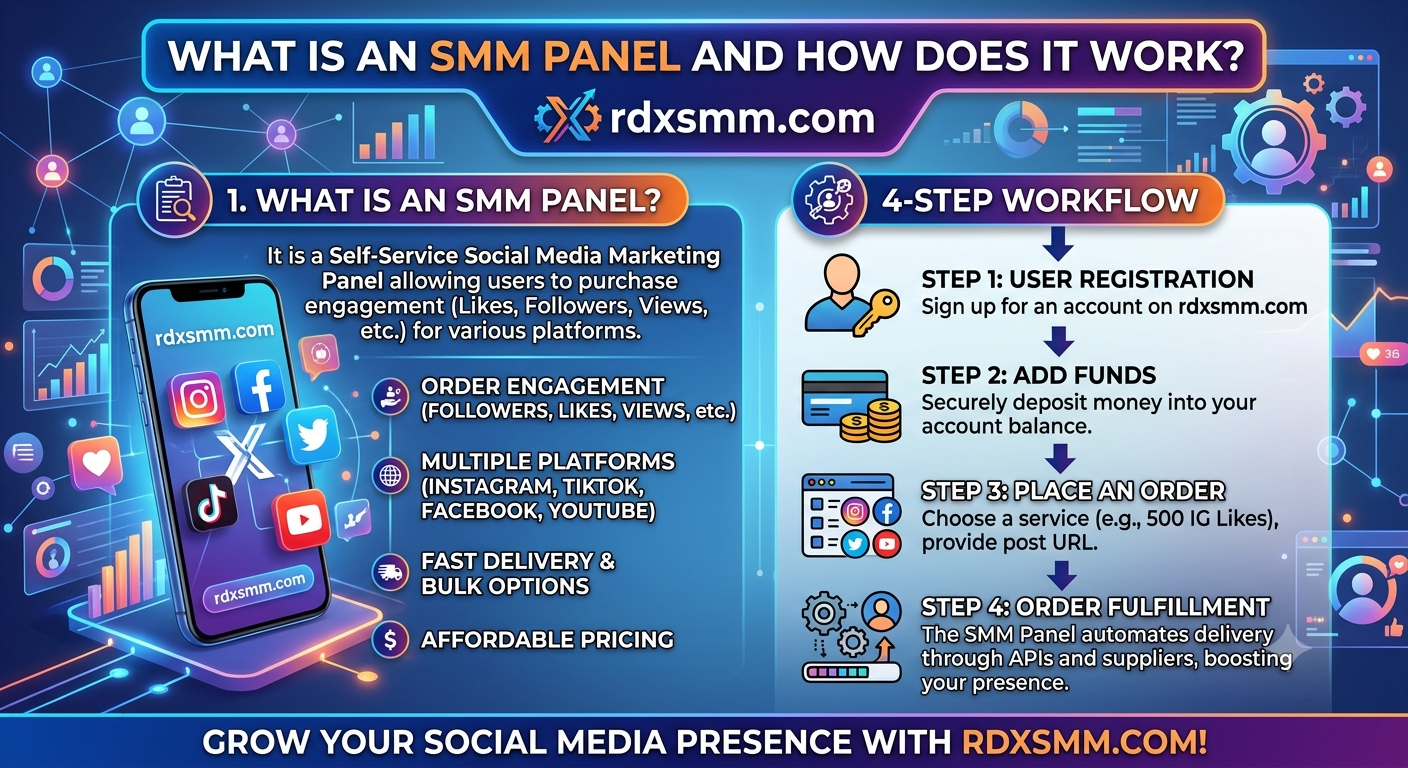
An SMM panel, short for Social Media Marketing panel, is an online dashboard where users can browse and order different social media marketing services from a single platform. Depending on the provider, services may include followers, likes, views, comments, subscribers, shares, and other forms of social-media promotion.
In this guide, we'll explain SMM panels in simple language, how the ordering process works, what an SMM panel API is, what to check before choosing a panel, and how RdxSMM.com fits into the SMM ecosystem.
What Does SMM Stand For?
SMM stands for Social Media Marketing.
An SMM panel is essentially a self-service platform that organizes social-media marketing services into a searchable catalogue.
Instead of contacting different providers individually, a user can typically:
- Create an account
- Add funds to their panel balance
- Browse available services
- Select a service
- Enter the required public post or profile URL
- Choose the quantity
- Place the order
- Monitor the order status
Many panels use a prepaid balance or wallet system, allowing users to add funds once and place multiple orders from that balance.
What Services Can You Find on an SMM Panel?
The exact catalogue depends on the panel and its providers, but common categories can include:
Instagram Services
- Instagram followers
- Instagram likes
- Instagram Reel views
- Instagram Story views
- Instagram comments
- Instagram engagement services
YouTube Services
- YouTube views
- YouTube subscribers
- YouTube likes
- YouTube comments
TikTok Services
- TikTok followers
- TikTok views
- TikTok likes
- TikTok shares
Other Platforms
Some panels also provide services for platforms such as Facebook, Telegram, X, and other social networks.
Because every provider has a different catalogue, users should always read the individual service description rather than assuming that every service works in exactly the same way.
How Does an SMM Panel Work?
The basic process is relatively simple.
Imagine that a customer wants to order an Instagram service through an SMM panel.
Step 1: Create an Account
The customer creates an account on the SMM panel and logs into the dashboard.
Some panels may also allow users to place certain orders without creating a traditional account, but account-based systems generally make order tracking easier.
Step 2: Add Funds
The user adds money to their panel balance using the payment methods supported by the platform.
Once the balance is available, the user can use it to place orders.
Step 3: Select a Service
The user chooses a platform and service.
For example:
Instagram → Reel Views
or
YouTube → Video Views
A service listing may show information such as:
- Service ID
- Price
- Minimum order
- Maximum order
- Estimated start time
- Delivery speed
- Refill or replacement terms
- Service description
The exact information varies between panels.
Step 4: Enter the Target Link
The user normally provides the relevant public profile, post, Reel, video, or other supported URL.
A reputable workflow should not require users to give an SMM panel their social-media password, cookies, or two-factor authentication codes. Link-based ordering is a common model for these services.
Step 5: Choose the Quantity
The customer enters the quantity permitted by the selected service.
For example, a service might have a minimum and maximum order limit.
The panel calculates the order cost based on the selected quantity and the service's pricing.
Step 6: Place the Order
After the customer confirms the order, the panel creates an order record.
The order may initially show a status such as:
- Pending
- Processing
- In progress
- Completed
- Partial
- Cancelled
- Refunded
The exact status names depend on the panel software.
Step 7: Delivery and Tracking
The panel's system or upstream provider processes the order.
The customer can then return to the dashboard to monitor the order status.
This automated workflow is one of the main reasons SMM panels are popular with people managing multiple social-media campaigns.
What Is an SMM Panel Provider?
An important term to understand is provider.
An SMM panel may not directly deliver every service listed on its website. Many reseller panels connect to upstream providers that fulfil orders. The panel essentially acts as the customer-facing storefront and order-management layer.
A simplified structure can look like this:
Service provider → SMM panel → Reseller/agency → End customer
However, the actual supply chain can be more complicated, and some businesses operate at multiple levels of the ecosystem.
This is why two SMM panels can offer services with similar names but have very different prices, delivery speeds, or service quality.
What Is an SMM Panel API?
An SMM panel API allows software to communicate with an SMM panel automatically.
API stands for Application Programming Interface.
For example, a reseller may have their own website. Instead of manually copying every customer order into another panel, their website can communicate with a provider's API.
A typical automated workflow looks like:
Customer places order → reseller website creates order → API sends order to provider → provider processes order → status is returned → reseller website updates customer
Common API functions can include:
- Getting the service list
- Checking prices
- Placing orders
- Checking order status
- Checking account balance
API-based automation is particularly useful for agencies and resellers handling many orders.
What Is a Reseller SMM Panel?
A reseller SMM panel is designed for people who want to sell social-media services to their own customers.
For example, suppose a reseller gets a service from an upstream provider at one rate.
The reseller can create their own storefront, set their own retail pricing, and sell the service to customers.
The difference between the selling price and underlying cost—after expenses—can represent the reseller's margin.
This is why SMM panels are used by:
- Freelancers
- Digital marketing agencies
- Social-media managers
- Influencer managers
- Entrepreneurs
- SMM resellers
SMM Panel vs Social Media Management Tool
These two concepts are often confused.
An SMM panel generally focuses on ordering specific social-media services through a dashboard.
A social media management tool usually focuses on activities such as:
- Scheduling posts
- Managing multiple accounts
- Creating content calendars
- Monitoring mentions
- Managing publishing workflows
- Analytics and reporting
They solve different problems.
For example, a business might use a social-media management platform to schedule content while using an SMM panel for certain promotional services.
Why Do People Use SMM Panels?
One major attraction is convenience.
Instead of dealing with multiple suppliers manually, users can access many services from one dashboard.
Other potential advantages include:
Multiple services in one place
Users can browse services for different social platforms from one account.
Automated ordering
API integration can reduce repetitive manual work for resellers.
Order tracking
Customers can usually monitor orders from their dashboard.
Service comparison
A panel may offer several services for the same platform, allowing users to compare pricing, speed, limits, and other terms.
Useful for resellers
Agencies and resellers can use API systems to integrate services into their own websites.
What Should You Check Before Choosing an SMM Panel?
Not every panel provides the same experience.
Before placing an order, check the following.
1. Service descriptions
Read the complete service description.
Don't choose a service based solely on its price.
2. Minimum and maximum orders
Make sure your desired quantity falls within the service's limits.
3. Delivery information
Look for clearly stated start times and estimated delivery information where available.
4. Refill or replacement policy
Some services may include refill or replacement terms. Check exactly what those terms cover before ordering.
5. Support
A responsive support system is important when an order encounters a problem.
6. Payment security
Use a payment method and website that you trust, and avoid sharing sensitive account credentials.
7. Test small
If you're using an unfamiliar service, testing a small order first can help you evaluate its actual performance before committing more money.
Is an SMM Panel the Same as Instagram Ads?
No.
An SMM panel and an official advertising platform are different things.
For example, Instagram advertising is an advertising system operated through Meta's advertising ecosystem.
An SMM panel is a third-party service platform that provides its own catalogue of social-media services.
They should not be treated as interchangeable.
If your objective is to attract customers, build brand awareness, or generate conversions, your broader marketing strategy should include appropriate content, advertising, audience targeting, and analytics.
Can an SMM Panel Replace Organic Social Media Marketing?
No.
An SMM panel should not be considered a replacement for good content.
A successful social-media strategy can involve:
Quality content + audience engagement + consistency + analytics + appropriate promotion
Organic content remains important because followers and engagement numbers alone don't automatically create customers or a strong community.
For example, a business with excellent products but poor content may struggle even if its social-media metrics look impressive.
How to Use an SMM Panel More Responsibly
If you decide to use an SMM panel, focus on transparency and account safety.
Never share your password
Use supported public URLs where applicable. Never give third-party services your password, cookies, recovery codes, or 2FA codes.
Understand what you're buying
Read the service description and terms before placing an order.
Don't focus only on the cheapest price
A lower price doesn't automatically mean better value.
Compare:
- Price
- Delivery
- Quality
- Limits
- Refill terms
- Support
- Reliability
Continue building genuine content
Use social-media services, where appropriate, as one component of a broader marketing strategy rather than treating them as a substitute for genuine audience development.
Why SMM Panel Prices Can Be Different
You may find apparently similar services with dramatically different prices across different panels.
That's because pricing can depend on:
- Upstream supplier costs
- Service quality
- Delivery characteristics
- Refill policies
- Panel margins
- Operating costs
- API costs
- Competition
Therefore, comparing only the headline price isn't enough.
A service costing slightly more may offer better terms or reliability than a cheaper alternative.
How RdxSMM.com Fits Into SMM
RdxSMM.com is an SMM panel designed to provide users with a centralized platform for browsing and ordering social-media marketing services.
Instead of searching for different services across multiple websites, users can explore the available catalogue through the RdxSMM dashboard.
If you're new to SMM panels, start by understanding the service description, minimum and maximum order limits, delivery information, and applicable terms before placing an order.
You can visit RdxSMM.com to explore the available services and learn how the platform works.
Frequently Asked Questions
What is an SMM panel?
An SMM panel is an online platform that provides access to social-media marketing services through a centralized dashboard. Common services can include followers, likes, views, comments, subscribers, and other promotional services.
What does SMM stand for?
SMM stands for Social Media Marketing.
How does an SMM panel work?
A typical panel allows users to add funds, choose a service, enter a supported public URL, select a quantity, place an order, and track the order through the dashboard.
What is an SMM panel API?
An SMM panel API allows software to communicate with a panel automatically. It can be used to retrieve services, place orders, check order status, and perform other supported functions.
Can I use an SMM panel for Instagram?
Many SMM panels offer Instagram-related services such as followers, likes, Reel views, Story views, and other services. Availability and terms vary by provider.
Do SMM panels need my Instagram password?
A link-based service should not require your Instagram password. Never provide your password, cookies, 2FA codes, or recovery information to an SMM provider.
Are SMM panels useful for resellers?
Yes. Resellers can use SMM panels and APIs to offer social-media services to their own customers and automate order processing.
Is the cheapest SMM panel always the best?
No. Price is only one factor. Service quality, delivery, support, limits, refill terms, and reliability should also be considered.
Final Thoughts
An SMM panel is essentially a centralized marketplace and order-management platform for social-media marketing services.
The basic process is straightforward:
Choose a service → add funds → enter the supported link → select quantity → place the order → monitor the status.
For resellers, APIs can take this process a step further by connecting their own website or application directly with an upstream service provider.
However, an SMM panel should be viewed as a marketing tool, not a replacement for quality content, audience research, community engagement, and a proper social-media strategy.
If you're looking for an SMM panel where you can explore social-media marketing services from one dashboard, visit RdxSMM.com and review the available services and their individual terms before ordering.
RdxSMM.com — explore social media marketing services from one platform.