Why Are My Instagram Reels Getting Low Views? 15 Reasons and How to Fix Them
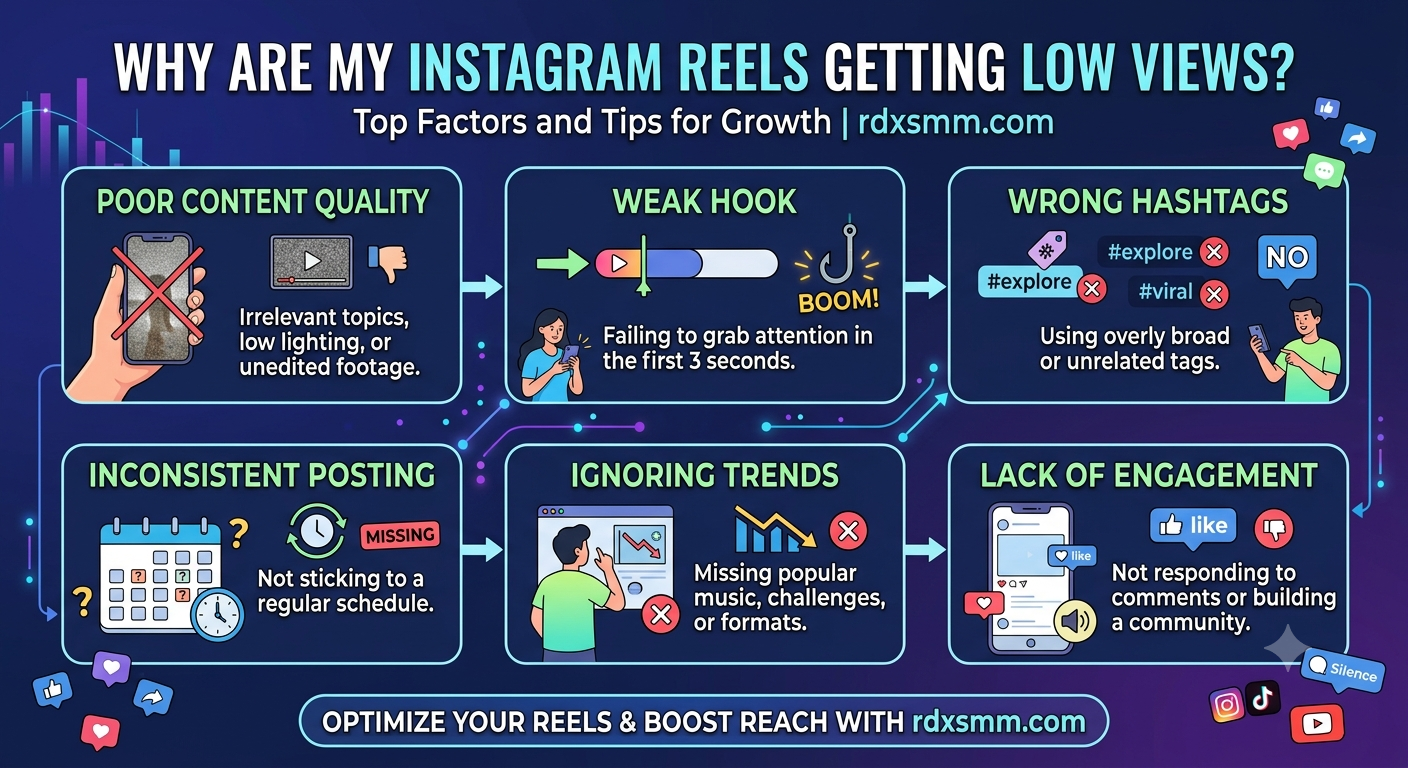
Why Are My Instagram Reels Getting Low Views? 15 Reasons and How to Fix Them
Have you ever spent time creating an Instagram Reel, edited it carefully, added a caption and hashtags, and then watched it receive surprisingly few views?
You're not alone.
“Why are my Instagram Reels getting low views?” is one of the most common questions among Instagram creators, businesses and influencers. Sometimes a Reel can perform extremely well, while another similar Reel barely reaches your existing audience.
Low Reel views don't necessarily mean that your Instagram account is permanently restricted or that you need to start a new account. There can be many reasons for poor performance, including the content itself, audience interest, the opening of the video, retention, consistency and overall content strategy.
This guide explains the most common reasons Instagram Reels get low views and practical ways to improve your reach.
Why Are My Instagram Reels Getting Low Views?
There isn't always one single reason.
Instagram content performance can vary depending on factors such as:
- How people respond to the Reel
- Whether viewers continue watching
- Whether people share or save the content
- How relevant the topic is to your audience
- The quality and originality of the content
- Your posting consistency
- The strength of your opening
- Your account's recommendation eligibility
- Competition for attention
Before assuming something is wrong with your account, look at the content and analytics carefully.
1. Your Reel Doesn't Have a Strong Hook
One of the biggest problems with low-performing Reels is a weak opening.
People scroll quickly through short-form content. If the first part of your video doesn't immediately communicate why someone should continue watching, they may move on.
Instead of:
“Hey guys, welcome back to my page…”
Try starting with something that creates immediate interest:
“Your Instagram Reels aren't getting views? Check these 3 things.”
Or:
“Stop making this mistake if you want more Reel views.”
The opening should clearly communicate the value of the video.
2. Your Content Takes Too Long to Get to the Point
A Reel doesn't necessarily need a long introduction.
If the useful information starts 10–15 seconds into the video, some viewers may leave before reaching it.
Try to remove unnecessary introductions and get to the main idea quickly.
For educational content, you can use a simple structure:
Hook → Problem → Solution → Example → Call to action
For entertainment content:
Hook → Build-up → Payoff
This keeps your content focused.
3. People Aren't Watching Your Reel Long Enough
Views are important, but they're not the only thing you should analyze.
If people repeatedly leave your Reel very early, that can indicate that the content isn't holding their attention.
Ask yourself:
- Is the introduction too slow?
- Is the video too repetitive?
- Does the video deliver what the opening promised?
- Is the text easy to understand?
- Is there unnecessary footage?
- Does the ending feel too long?
Try creating a shorter version of the same idea and compare the results.
4. Your Topic Isn't Relevant to Your Audience
Sometimes the problem isn't your editing.
It's the topic.
Imagine an account that normally posts fitness content suddenly publishes five videos about cryptocurrency. Even if the videos are professionally edited, the existing audience may not be interested.
Before creating a Reel, ask:
“Would my target audience actually care about this?”
Create content around:
- Frequently asked questions
- Problems your audience has
- Popular discussions in your niche
- Tutorials
- Useful tips
- Entertaining situations related to your niche
5. You're Posting Without a Clear Niche
An account that constantly changes topics can make it difficult to build a consistent audience.
For example:
Monday: Fitness
Tuesday: Gaming
Wednesday: Fashion
Thursday: Cooking
Friday: Cryptocurrency
You may reach different people, but it becomes harder to develop a clear content identity.
You don't need to talk about only one subject forever, but having a few closely related content pillars can help.
Example:
A digital marketing account could focus on:
- Instagram tips
- Content creation
- Social media marketing
- SMM education
These topics naturally support each other.
6. Your Reel Isn't Easy to Understand Without Sound
Many people encounter short-form videos in situations where they may not immediately listen to the audio.
Consider adding clear on-screen text when appropriate.
Your viewer should be able to understand the basic idea of the Reel quickly.
However, don't cover the entire screen with text.
Keep important information:
- Short
- Readable
- Well positioned
- Relevant to the video
7. Your Video Quality Needs Improvement
You don't need an expensive camera to create successful Reels.
A modern smartphone can be enough.
But avoid obvious quality problems such as:
- Extremely dark footage
- Unclear audio
- Excessive compression
- Shaky footage
- Tiny text
- Poor framing
- Distracting backgrounds
Good lighting and clear audio can make a surprisingly large difference to how professional your content feels.
8. You're Reusing Content Without Adding Anything New
If your Reel is simply copied from another platform or creator without meaningful changes, it may not provide much original value.
Instead of copying another creator's video, take the idea and create your own version.
For example:
Someone posts:
“5 Instagram mistakes.”
You can create:
“5 Instagram mistakes I see small businesses making.”
Add your own examples, explanation and experience.
The goal is to create content that gives viewers a reason to watch your version.
9. Your Reels Are Too Repetitive
Posting the same concept repeatedly can cause your content to become less interesting.
Instead of producing:
“3 Instagram tips”
50 times, develop different angles:
- 3 Instagram mistakes
- 5 Reel hook ideas
- Why your Reels aren't getting views
- How to improve Reel retention
- Instagram content ideas
- Reels strategy for beginners
- Reels ideas for businesses
You can stay within your niche while keeping your content fresh.
10. You're Ignoring Your Instagram Analytics
If your Reels aren't performing well, don't guess blindly.
Review your available insights and compare your better-performing content with your weaker posts.
Look for patterns involving:
- Views
- Reach
- Likes
- Comments
- Shares
- Saves
- Profile visits
- Follows
- Watch/retention-related metrics where available
For example, suppose you have:
Reel A: 1,000 views
Reel B: 12,000 views
Don't simply say, “Reel B went viral.”
Ask:
What was different?
Was the topic better?
Was the opening stronger?
Was the video shorter?
Did more people share it?
Did the Reel answer a specific question?
This type of analysis is much more useful than randomly changing your strategy.
11. Your Captions and Calls to Action Aren't Helping
A caption shouldn't exist simply because Instagram provides a caption box.
Use it to provide context or encourage meaningful interaction.
For example:
“Which of these Instagram mistakes have you made? Tell me below.”
You can also direct people toward a useful resource when appropriate.
Avoid making every post say:
“Like, comment, share and follow!”
A natural and relevant call to action is usually better.
12. You're Posting Inconsistently
You don't need to post ten Reels every day.
In fact, producing large amounts of low-quality content just to maintain volume can make your workflow harder.
Create a sustainable schedule.
For example:
3–5 quality Reels per week
Then use your analytics to determine which topics and formats deserve more attention.
Consistency gives you more opportunities to learn what your audience responds to.
13. You're Expecting Every Reel to Go Viral
This is one of the biggest mindset mistakes.
Not every Reel will perform equally.
One Reel might receive:
800 views
Another:
4,000 views
Another:
50,000 views
And occasionally one may perform far beyond your normal range.
The goal shouldn't be to make every Reel viral.
The goal is to continuously improve your average performance.
If your typical Reel goes from 500 views to 2,000 views, that's meaningful progress even if you haven't reached 100,000 views.
14. Check Whether Your Content Is Eligible for Recommendations
If your content isn't being recommended as expected, don't immediately assume that Instagram has “shadowbanned” your account.
Check the account and content status information available within Instagram.
If Instagram indicates that specific content isn't eligible for recommendations, review the relevant reason and make changes where appropriate.
Also make sure your content follows Instagram's rules and recommendations guidelines.
15. You're Focusing Only on Views
This is perhaps the most important point.
Views aren't the entire story.
Imagine two Reels:
Reel A
20,000 views
300 profile visits
20 followers
Reel B
8,000 views
600 profile visits
100 followers
Which one is more useful for your account?
It depends on your objective, but Reel B may be producing a much stronger business or audience result despite having fewer views.
Track the metrics that actually matter to your goal.
How to Increase Instagram Reels Views
Now that we've covered the common problems, here's a simple strategy you can test.
Step 1: Choose a Specific Topic
Don't create a Reel simply because you need to post something.
Choose one specific problem or question.
Example:
“Why are my Instagram Reels getting low views?”
Step 2: Create a Strong Opening
Give viewers a reason to continue.
Example:
“If your Reels suddenly stopped getting views, check these five things before posting another video.”
Step 3: Deliver the Answer Quickly
Don't spend half the video introducing yourself.
Start solving the problem.
Step 4: Keep the Video Focused
One Reel should ideally communicate one clear idea.
If you have ten different tips, consider turning them into a series.
For example:
Part 1: Reel hook mistakes
Part 2: Retention mistakes
Part 3: Content mistakes
Part 4: Profile mistakes
Step 5: Create Better Thumbnails and Covers
Your Reel cover can help communicate what the video is about when people visit your profile.
Use short, readable text.
For example:
“LOW REEL VIEWS?”
is easier to understand than:
“Here are some reasons why you might possibly be experiencing lower-than-expected Instagram Reel views.”
Step 6: Experiment
Don't assume one format is the answer.
Test:
- Talking-head videos
- Tutorials
- Screen recordings
- Educational Reels
- Storytelling
- Before/after formats
- Lists
- Short explanations
- Questions and answers
Then use your results to decide what to produce more often.
Should You Delete Reels With Low Views?
Usually, don't panic and immediately delete every Reel that performs poorly.
A low-view Reel can still provide useful information.
Instead, analyze it.
Ask:
What can I learn from this post?
If the idea was good but the opening was weak, remake the concept with a stronger hook.
If the topic was unpopular, try a different subject.
If viewers didn't understand the video, improve the presentation.
Should You Start a New Instagram Account Because Your Reels Have Low Views?
Not necessarily.
Starting a completely new account doesn't automatically solve a content-performance problem.
Before creating a new account, review:
- Your niche
- Content quality
- Audience
- Posting consistency
- Analytics
- Recommendation eligibility
- Previous content performance
If the fundamental problem is your content strategy, a new account may eventually experience the same problem.
Can an SMM Panel Increase Instagram Reel Views?
SMM panels such as RdxSMM.com can provide social media marketing services, but purchasing a service should not be treated as a replacement for creating useful content.
If you're using an SMM panel as part of your broader marketing strategy, evaluate services carefully and understand what you're purchasing.
Your long-term Instagram strategy should still focus on:
Original content + audience relevance + strong hooks + retention + consistency + analytics.
You can visit RdxSMM.com to explore the social media marketing services available on the platform.
Frequently Asked Questions
Why are my Instagram Reels suddenly getting low views?
A sudden decrease can have several possible causes, including changes in audience response, content topic, retention, posting patterns, recommendation eligibility, or normal fluctuations in distribution. Compare recent Reels with your historically better-performing content before drawing conclusions.
Why are my Reels getting 0 or very few views?
Check that the Reel has published correctly, review your account/content status, and examine whether the content follows Instagram's guidelines. If the issue continues across multiple posts, analyze your content strategy and account analytics.
How can I get more views on Instagram Reels?
Create content around topics your audience actually wants, use strong openings, keep videos focused, improve retention, experiment with formats, post consistently and study your analytics.
How often should I post Reels?
There isn't one universal number. Choose a frequency you can maintain while keeping your content useful and original.
Do hashtags guarantee more Reel views?
No. Hashtags shouldn't be treated as a guaranteed method for increasing views. Relevant content and audience response are much more important parts of an overall strategy.
Should I buy Reel views?
Don't rely on purchased views as a substitute for genuine audience growth. If your goal is long-term reach, focus on content quality, relevance, retention and audience engagement.
How long does it take for a Reel to get views?
There isn't a fixed timeline. Different Reels can receive different levels of distribution at different times. Analyze performance over time rather than assuming that one early result determines the final outcome.
Final Thoughts
If your Instagram Reels are getting low views, don't immediately assume that your account is broken.
Start with the basics:
Improve the hook.
Choose better topics.
Make the content easier to understand.
Keep viewers interested.
Study your analytics.
Create consistently.
Experiment with different formats.
Most importantly, don't judge your entire Instagram strategy based on one or two Reels.
Treat every post as an opportunity to learn what your audience wants.
And if you're looking for social media marketing services to complement your broader marketing strategy, visit RdxSMM.com and explore the available services.
Better content creates better opportunities for sustainable Instagram growth.