Why Are SMM Panel Prices Different? A Complete Guide for Indian Users
Why Are SMM Panel Prices Different? A Complete Guide for Indian Users
If you have ever searched for an SMM panel in India, you may have noticed something confusing: two websites can offer the same type of Instagram followers, likes, views, or YouTube services but charge completely different prices.
One panel might advertise a service at ₹10 per 1,000, another at ₹50, and another at ₹200 or more.
So, why are SMM panel prices different?
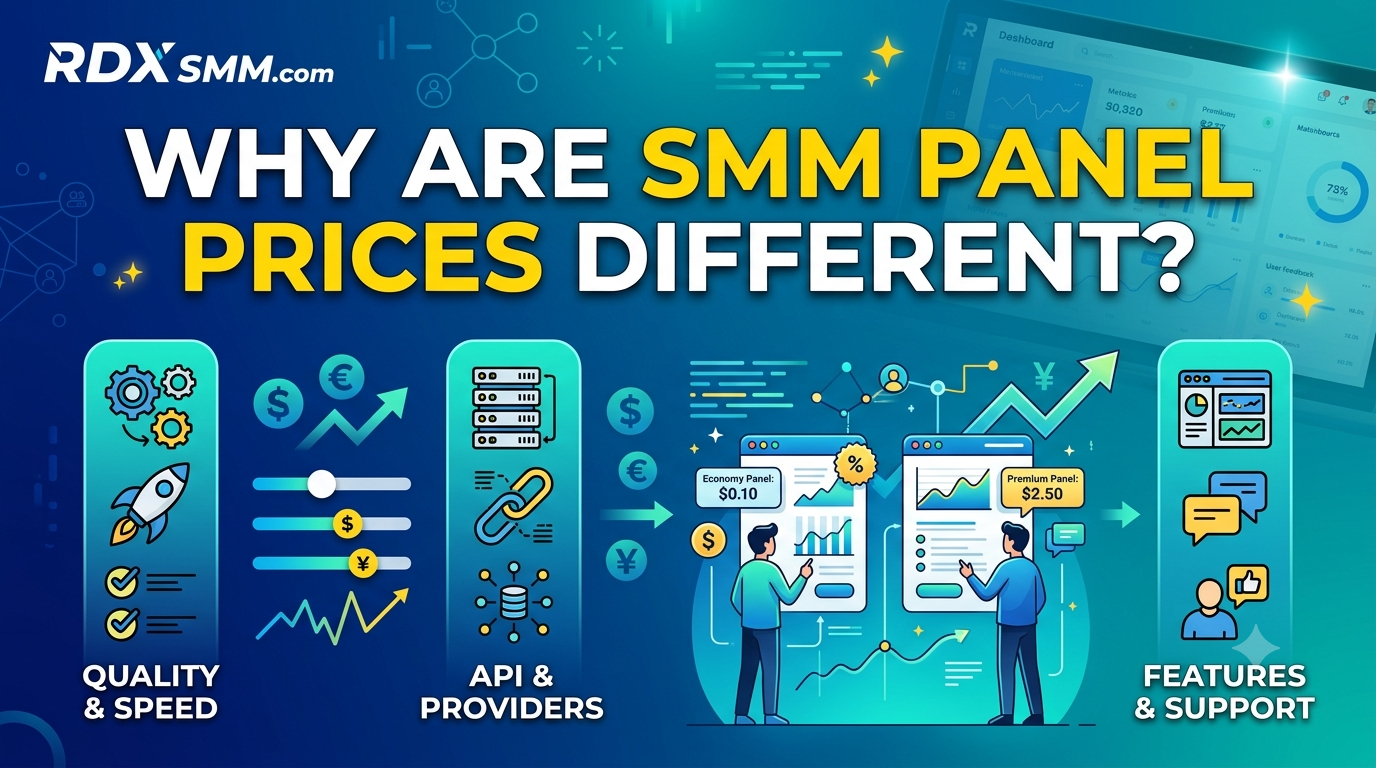
The answer is that an SMM panel price is influenced by several factors, including the provider's source cost, service type, quality level, delivery speed, refill policy, API costs, operating expenses, payment methods, order volume, and the reseller's markup.
Understanding these factors can help Indian buyers and resellers compare SMM services more intelligently instead of choosing a service based only on the lowest displayed price.
What Is an SMM Panel?
An SMM panel, or Social Media Marketing panel, is an online platform where users can access different social media marketing services from a single dashboard.
Depending on the platform, services may include:
- Instagram followers
- Instagram likes
- Instagram Reel views
- Instagram Story views
- YouTube views
- YouTube subscribers
- Facebook services
- Telegram services
- TikTok services
- Other social media marketing services
Many reseller panels connect to external providers through APIs. The customer's order can then be forwarded automatically to a service provider.
This means that the price displayed on a reseller panel is not necessarily the original wholesale cost of the service.
Why Are SMM Panel Prices Different?
There isn't one universal SMM panel price. Different providers operate with different supply chains and business models.
Here are the major reasons.
1. Different Service Providers Have Different Costs
One of the biggest reasons for price differences is the provider behind the service.
A reseller may obtain a service directly from a wholesale provider, while another reseller may purchase the same category of service through one or more intermediaries.
For example, a simplified supply chain might look like:
Primary provider → Wholesale panel → Reseller panel → Customer
Every additional layer can add its own operating costs and markup.
Some SMM businesses use API connections to automate order placement and status tracking, which can reduce manual processing.
Therefore, two panels can show very different prices even when their service names look similar.
2. Service Quality Can Be Different
The words used in an SMM service name don't always tell you everything about the underlying service.
For example, two services might both be called:
Instagram Followers
But their characteristics could differ considerably.
One service might have:
- Different account sources
- Different retention characteristics
- Different delivery speeds
- Different refill terms
- Different targeting options
Another may have completely different specifications.
That's why comparing only the headline price can be misleading.
Before ordering, check the complete service description and understand what the provider actually promises.
3. Delivery Speed Affects Pricing
Delivery speed can also influence the price.
A provider may offer several options for the same general type of service:
Gradual delivery
The requested quantity is delivered over a longer period.
Fast delivery
The order is completed within a shorter period.
Instant-style delivery
The provider begins processing very quickly.
Faster delivery can involve different infrastructure or supply arrangements, so the price may be different.
However, faster doesn't automatically mean better. The appropriate option depends on what the customer needs and what the service actually guarantees.
4. Refill Policies Can Change the Price
Another important factor is the refill policy.
Some services may include a refill period if the delivered quantity drops within specified conditions. Other services may have no refill coverage.
For example, a panel could offer:
- No refill
- 7-day refill
- 30-day refill
- 90-day refill
- 365-day refill
A service with a longer stated refill period may cost more because the provider is taking on additional replacement obligations.
Always read the exact refill conditions. A "refill" isn't necessarily an unconditional guarantee of permanent retention.
5. Indian SMM Panels May Use INR and Local Payment Methods
Indian users often prefer platforms that display prices directly in Indian rupees (INR) and support familiar payment methods.
Some Indian-oriented SMM platforms advertise UPI, INR billing, and reseller API access.
A panel serving international customers may instead price everything in USD.
Currency conversion, payment processing, international transaction costs, and currency fluctuations can affect the final amount paid by an Indian customer.
This is one reason comparing the final INR cost is more useful than comparing a headline USD price.
6. Order Volume Can Affect Wholesale Pricing
Large providers can process a significant number of orders.
When purchasing services at wholesale scale, the provider may offer different rates depending on volume, account level, or negotiated arrangements.
For a reseller, the difference between wholesale and retail pricing becomes part of the business model.
A simplified example:
Provider cost: ₹20
Reseller selling price: ₹35
Gross difference: ₹15
This ₹15 isn't automatically pure profit because the reseller may still have expenses such as:
- Hosting
- Domain
- Payment processing
- Customer support
- Software
- Taxes
- Refunds or replacements
- Marketing
- API/provider costs
Therefore, a higher retail price doesn't necessarily mean the panel is simply "overcharging."
7. API Infrastructure Matters
Many modern SMM reseller panels use APIs to automate orders.
A typical API workflow can allow a reseller's website to:
- Display available services
- Receive a customer's order
- Send the order to a provider
- Receive an order ID
- Check delivery status
- Update the customer's dashboard
This automation reduces the need for manual order processing.
However, API access and infrastructure still have operating costs, and different providers can have different technical setups.
8. Different Panels Have Different Operating Expenses
Running an SMM panel isn't only about the cost of the social media service.
A panel operator may need to pay for:
- Website hosting
- VPS/server infrastructure
- Panel software
- API infrastructure
- Payment gateway fees
- Customer support
- Developers
- Security
- Backups
- Marketing
- Domain registration
A panel with a larger support team or more infrastructure may have higher operating expenses than a very small reseller.
Those costs can be reflected in the final service price.
9. Payment Methods Can Affect the Final Cost
For Indian customers, payment convenience is another consideration.
UPI has become an important payment method for online transactions in India, and some SMM platforms specifically advertise UPI and INR support.
A panel that supports convenient local payments may have different processing costs from a platform that relies primarily on international payment methods.
Always compare the actual amount you pay, including any payment-related charges.
10. Reseller Markup Is Different From Panel to Panel
Many SMM panels operate as resellers.
That means they purchase a service from a provider and sell it to their own customers at a different price.
For example:
Provider → ₹15 per 1,000
Panel A → ₹25 per 1,000
Panel B → ₹40 per 1,000
The difference can come from the panel's markup and operating costs.
Some reseller platforms explicitly describe this model as buying services through wholesale providers and reselling them at a higher retail price.
11. The Cheapest Service Isn't Necessarily the Same Service
This is one of the most important things to understand.
Suppose you find:
Panel A: ₹10
Panel B: ₹25
Panel C: ₹50
It would be a mistake to assume that all three provide exactly the same thing.
Check:
- Service description
- Minimum order
- Maximum order
- Delivery speed
- Refill policy
- Drop expectations
- Targeting
- Service availability
- Support
- Refund conditions
Only after checking these details can you make a meaningful comparison.
12. Prices Can Change Over Time
SMM panel pricing isn't necessarily permanent.
Provider costs, availability, demand, platform changes, competition, and supplier arrangements can all affect pricing.
Some SMM websites explicitly state that their rates can change as provider rates and market conditions change.
Therefore, an article or screenshot showing a particular price should not automatically be treated as a permanent market price.
Always check the current rate directly on the panel before placing an order.
How to Compare SMM Panel Prices in India
Instead of asking only:
"Which panel is cheapest?"
use a broader checklist.
Step 1: Compare the actual service
Make sure you're comparing the same type of service.
Step 2: Check the price per 1,000
This makes different package sizes easier to compare.
Step 3: Check the minimum order
A ₹5 service with a 10,000 minimum isn't necessarily useful if you only need 1,000.
Step 4: Check delivery information
Look at the stated start time and expected delivery period.
Step 5: Check refill terms
Read exactly when and how refill coverage applies.
Step 6: Check support
A cheap service can become expensive if problems are difficult to resolve.
Step 7: Check payment options
Indian users may prefer INR and UPI options for convenience.
Step 8: Test before scaling
If you're a reseller, consider testing a service with a small order before committing significant funds.
Why RdxSMM.com Can Be Useful for Price Comparison
RdxSMM.com is an SMM panel designed around social media marketing services for users who want to manage orders through one online platform.
Instead of looking at the price alone, users can evaluate the available service information, order requirements, delivery details, and other terms before deciding what fits their needs.
For Indian users and resellers, comparing prices in INR can also make it easier to understand the actual cost of a service.
Visit RdxSMM.com to explore the available social media marketing services and compare the current rates shown on the platform.
SMM Panel Pricing: Frequently Asked Questions
Why is one SMM panel cheaper than another?
The difference can come from provider costs, reseller markup, service quality, delivery speed, refill policies, operating expenses, payment costs, and purchasing volume.
Are cheap SMM panels always low quality?
Not necessarily. Price alone doesn't establish service quality. Compare the service specifications, delivery terms, refill policy, and support before making a decision.
Why do Instagram follower prices vary so much?
Different follower services can have different sources, targeting, delivery methods, retention characteristics, and refill terms. Two services with the same basic label may therefore have very different prices.
Why do SMM panel prices change?
Provider rates, availability, competition, demand, currency costs, and service conditions can change over time.
What should I check before buying an SMM service?
Check the exact service description, price, minimum and maximum order, delivery information, refill terms, cancellation/refund conditions, and customer support.
Is an Indian SMM panel better for Indian users?
An Indian-focused panel may offer conveniences such as INR pricing or UPI payment, but users should compare the actual service terms and quality rather than choosing a panel based only on its location.
Final Thoughts
There is no single reason why SMM panel prices are different.
The final price is usually the result of several factors working together:
Provider cost + service characteristics + delivery method + refill terms + operating costs + payment costs + reseller markup = final customer price.
That's why comparing SMM panels only by the cheapest number can give you an incomplete picture.
Whether you're a creator, business owner, freelancer, or SMM reseller in India, take a few minutes to compare the service specifications, delivery conditions, refill policy, support, and total cost before placing an order.
For users looking for an SMM platform in India, you can explore the current services and pricing available at RdxSMM.com.
Note: Social-media platforms can change their rules and policies, and third-party engagement services may not be treated the same way as organic growth. Always review the applicable platform rules before using any promotional service.